
Last updated September 20, 2026
Free on-site gate assessment - hinges, posts, and your LiftMaster or Nice gate operator checked before anything is quoted
The assessment is free and the quote is the invoice.

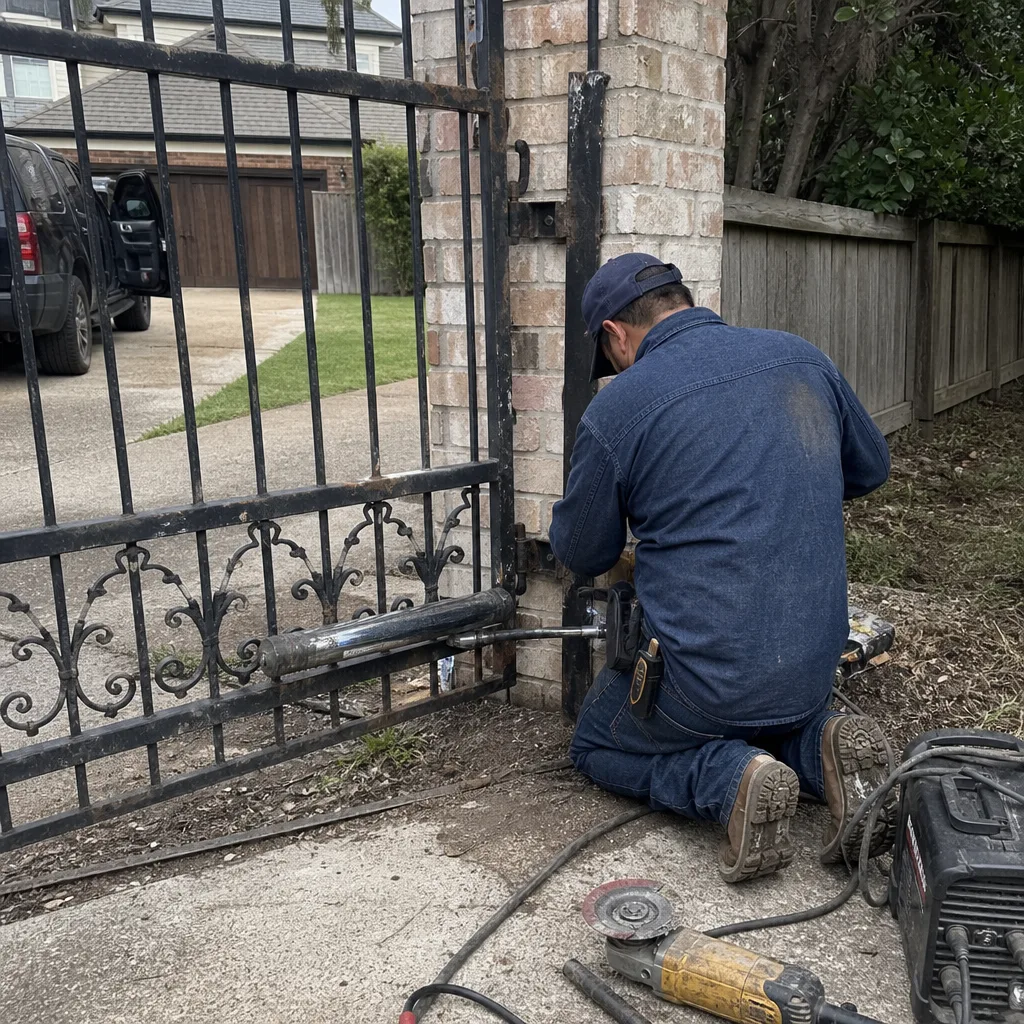 Before
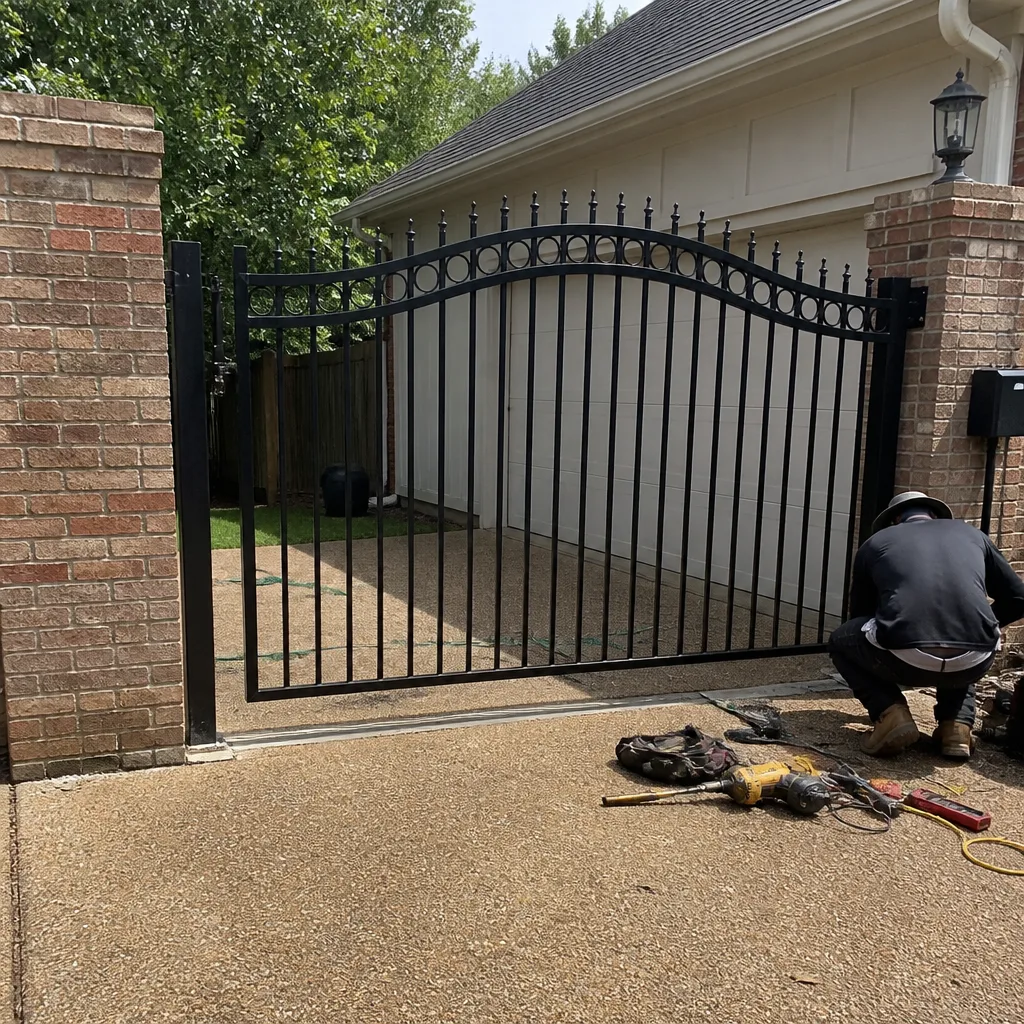 After
After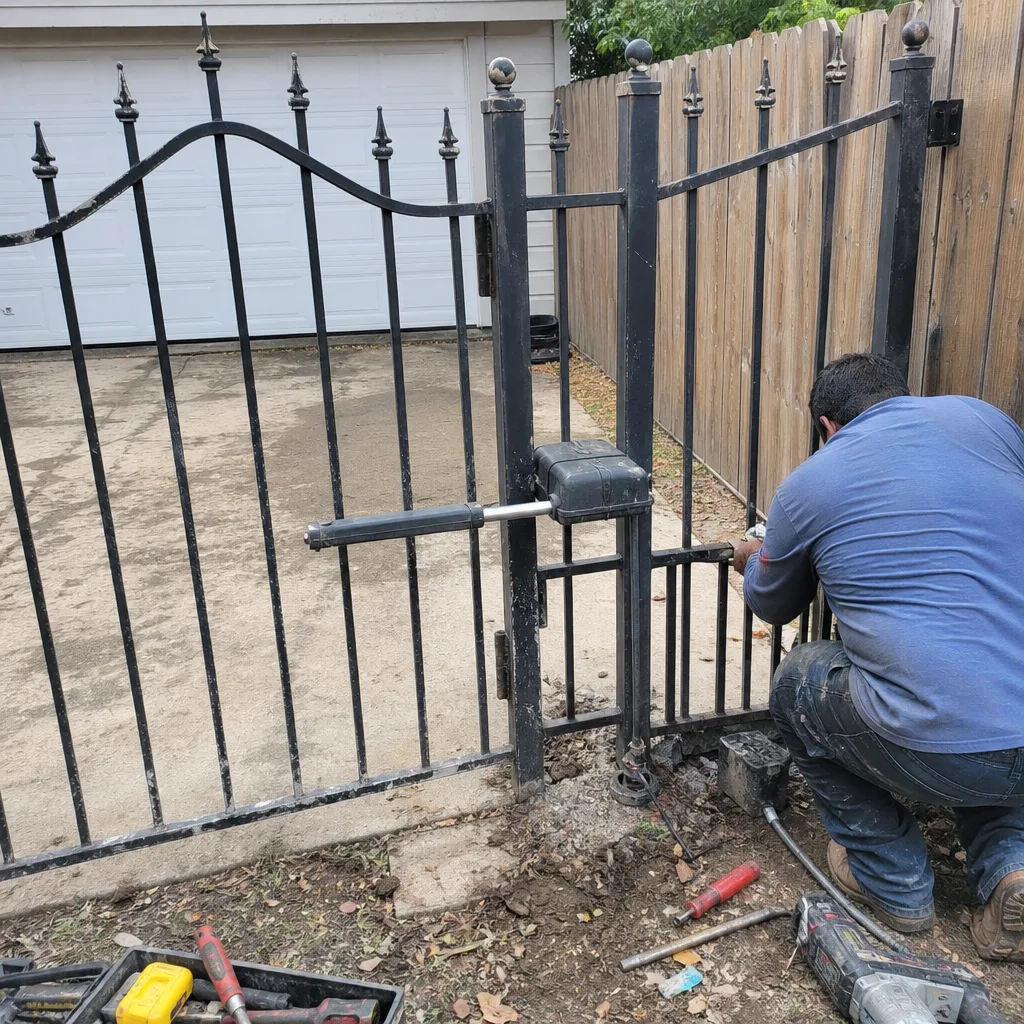 Before
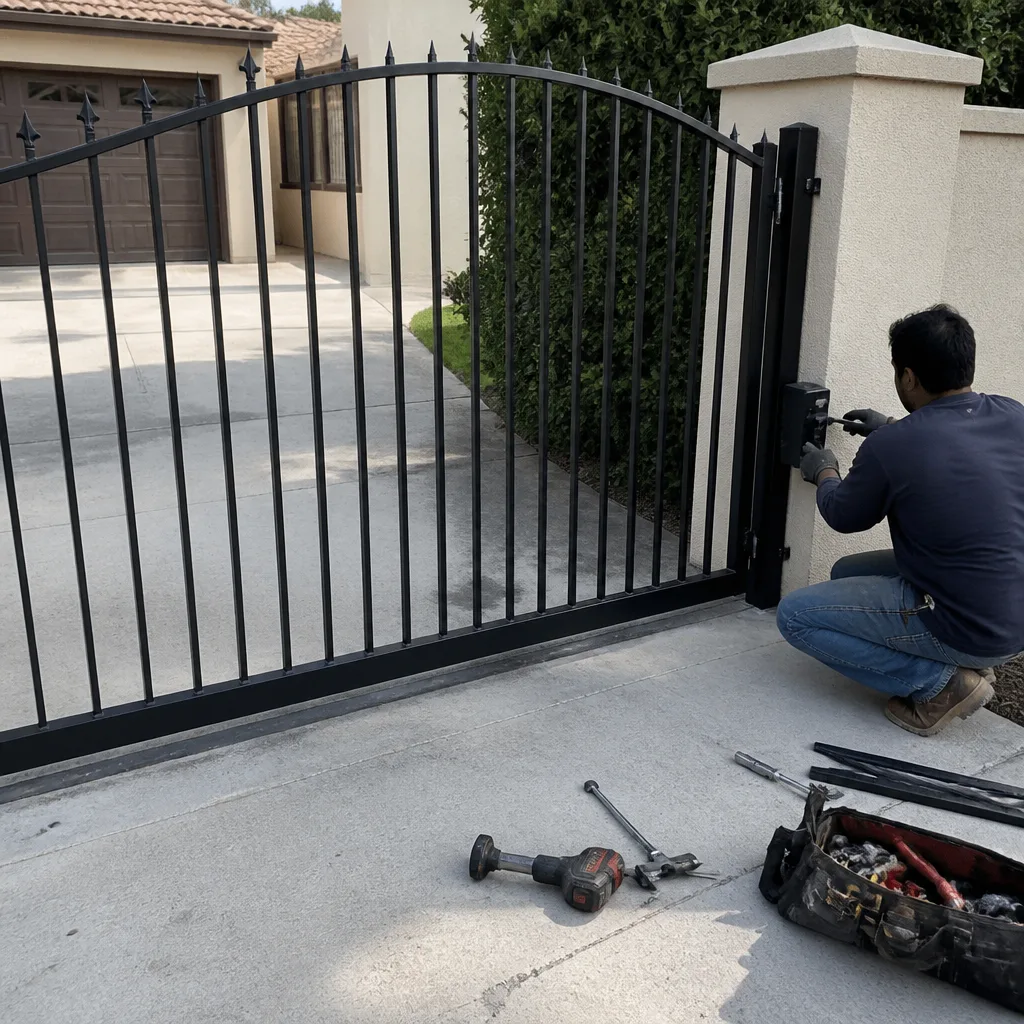 After
After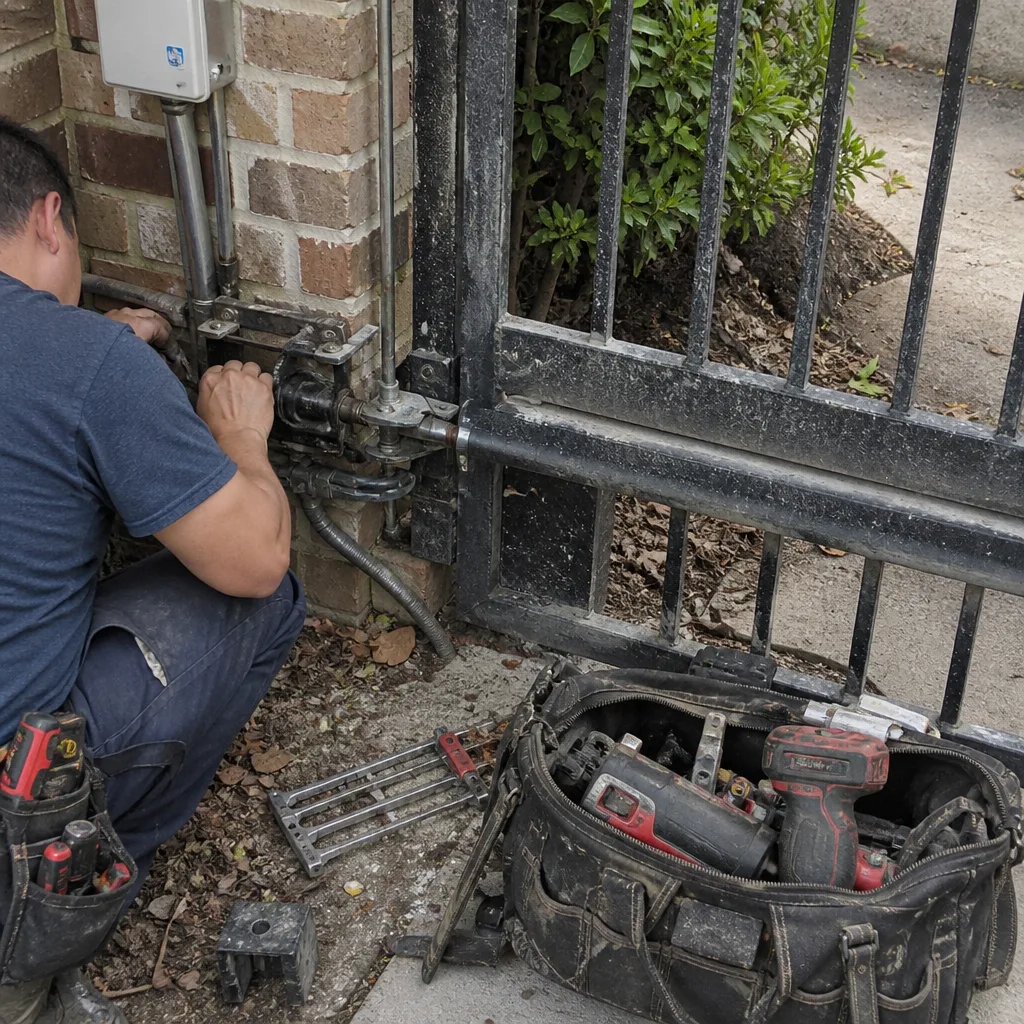 Before
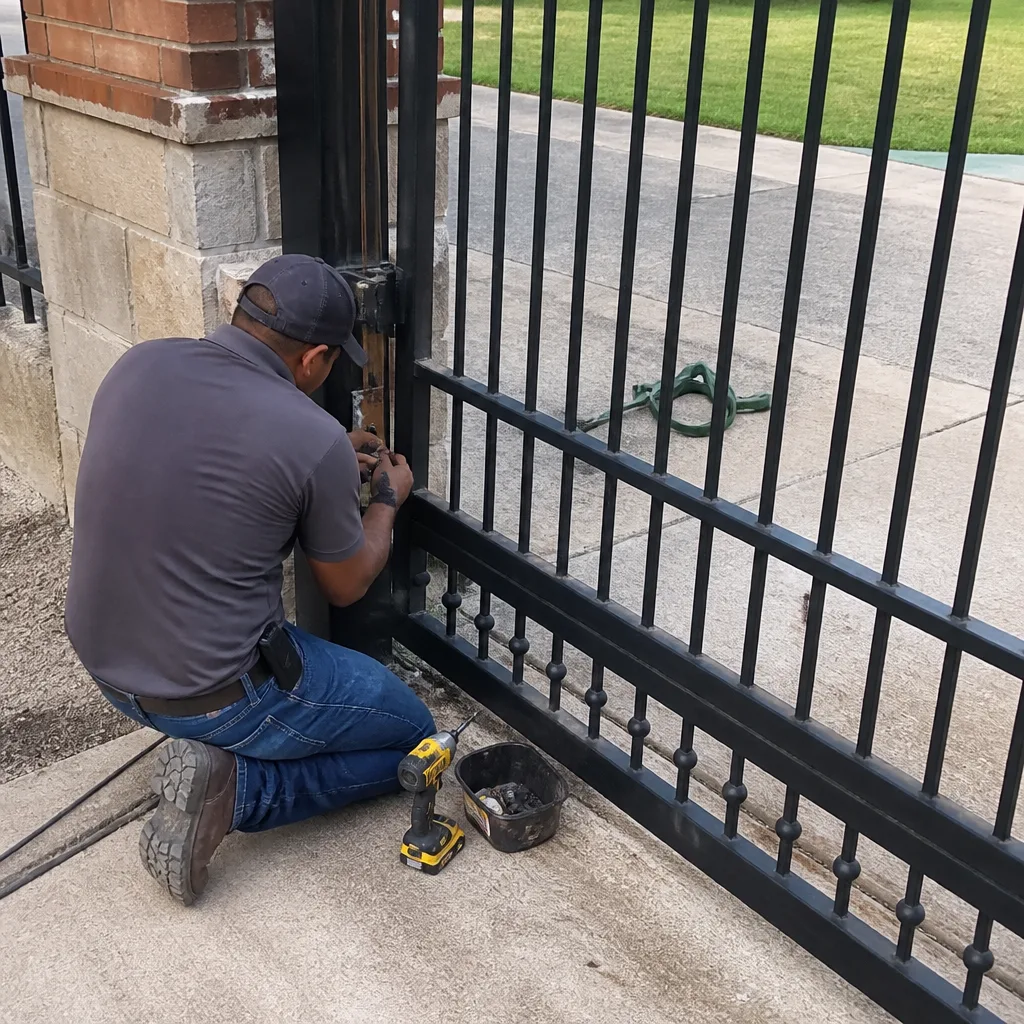 After
AfterSeasonal Gate Repair Care for Sugar Land: Year-Round Homeowner’s Guide
Most gate problems in Sugar Land are not random. They’re seasonal, predictable, and tied to a specific geological fact: Fort Bend County sits on expansive clay soil that swells when wet and shrinks when dry. A gate calibrated in August, when the ground is at peak shrink and the post has leaned to its maximum dry-weather position, will bind by February when the clay swells back and the post straightens or tilts the opposite way. This guide explains the exact seasonal failure patterns we see across Sugar Land, when to perform maintenance so it actually holds, and how to document your gate’s drift profile so you’re never surprised by the same gate repair twice.
Quick Answer
Seasonal gate care in Sugar Land means calibrating your gate during the two soil-stable windows: mid-October through Thanksgiving, and late February through early April. For The Complete Guide to Gate Repair in Sugar Land, see our detailed breakdown of local soil conditions and maintenance timing. These are the only periods when Fort Bend County’s clay soil is neither aggressively shrinking nor swelling, so limit-switch adjustments, post alignments, and track leveling actually hold through the extremes that follow. Work done in August or January often requires re-adjustment within 60 days because the ground itself moves beneath the gate.
Table of Contents
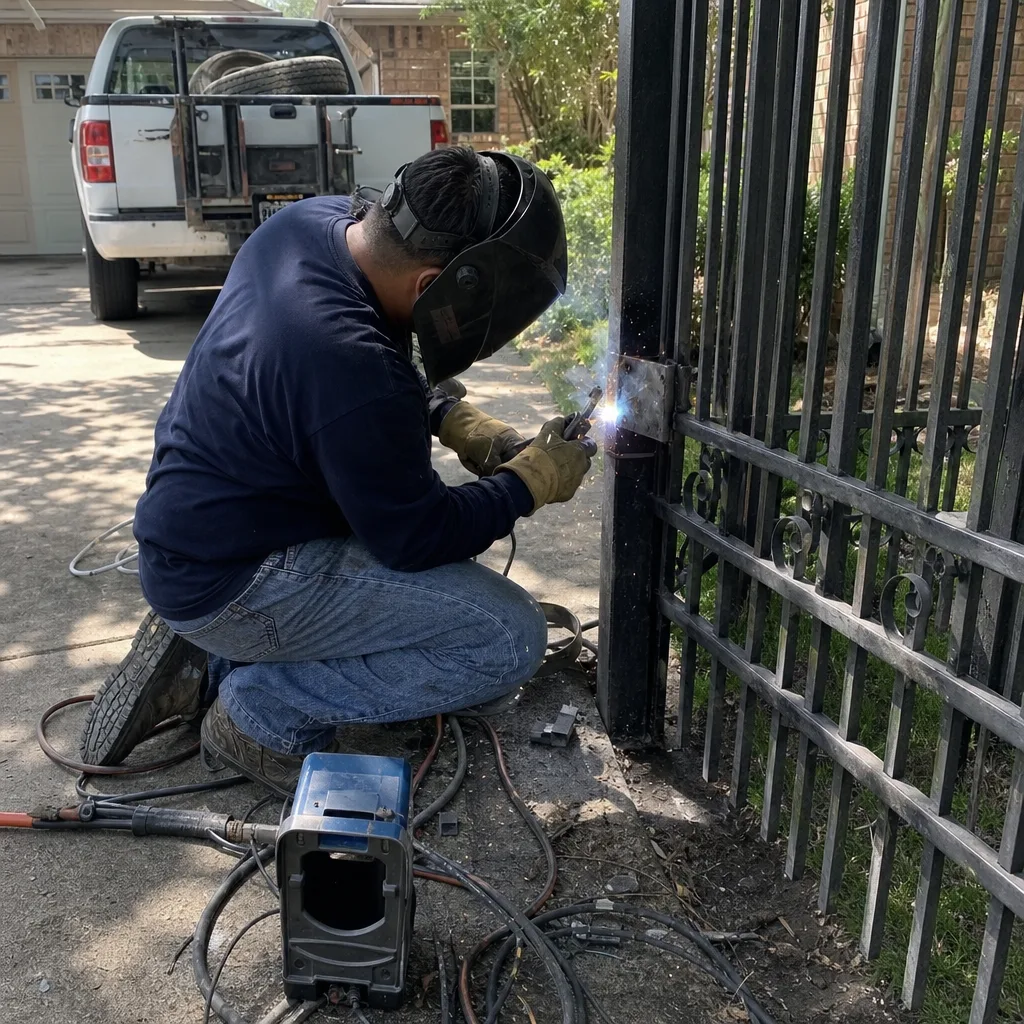
- The Clay Soil Calendar: How Fort Bend County Ground Movement Changes Your Gate
- Summer Heat Failures: Photo-Eyes, Batteries, and Aluminum Track
- Winter Condensation: Control Boards and the Freeze Windows Sugar Land Gets
- The Fall Calibration Window: Mid-October to Thanksgiving
- The Spring Window: Late February Through Early April
- Building a Drift Profile: Documenting Seasonal Readings by Month
- Brand-Specific Seasonal Notes: FAAC, BFT, and Linear
- Common Mistakes to Avoid
- When to Call a Professional
- Frequently Asked Questions
- The Bottom Line
BeforeAfterThe Clay Soil Calendar: How Fort Bend County Ground Movement Changes Your Gate
Sugar Land’s soil is predominantly the Beaumont and Lake Charles clay series, both classified as high-plasticity expansive clays. What this means in practical terms: the ground beneath your gate post can move vertically by one to two inches between a dry August and a wet February. That vertical movement is not uniform. The post closest to a drainage swale or a frequently irrigated flower bed will move differently than the post on the dry side of the driveway, which is how a swing gate that cleared its latch by a comfortable half-inch in summer ends up dragging against the strike plate by winter.
The movement pattern follows a loose calendar. From June through September, sustained heat and minimal rainfall pull moisture out of the top several feet of soil. The clay shrinks, small cracks open near the surface, and the gate posts lean outward or inward depending on the load they carry and the depth of their concrete footer. A post set in a 36-inch footer with a 400-pound cantilevered slide gate on top will lean measurably by late August. In most Sugar Land neighborhoods we work in, from First Colony to Greatwood, the lean is subtle enough that homeowners don’t notice it visually. But the gate notices. The latch alignment drifts, the photo-eye beam gets interrupted by a quarter-inch of misalignment, and the auto-close feature starts reversing because the gate thinks something is in the path.
Then comes October. Rain returns, soil moisture climbs, and the clay begins to swell. The swelling doesn’t happen evenly over a weekend; it takes weeks, and it continues through the winter as cold fronts bring sustained moisture. By February, the soil has reached near-maximum expansion, the posts have shifted again, and any calibration work done in August now fights against a gate that is geometrically different from the one that was adjusted.
This is why our Gate Repair in Sugar Land service always asks one question before scheduling calibration work: what month did the problem start? The answer tells us whether we’re looking at a soil-movement issue, a component failure, or both.
Summer Heat Failures: Photo-Eyes, Batteries, and Aluminum Track
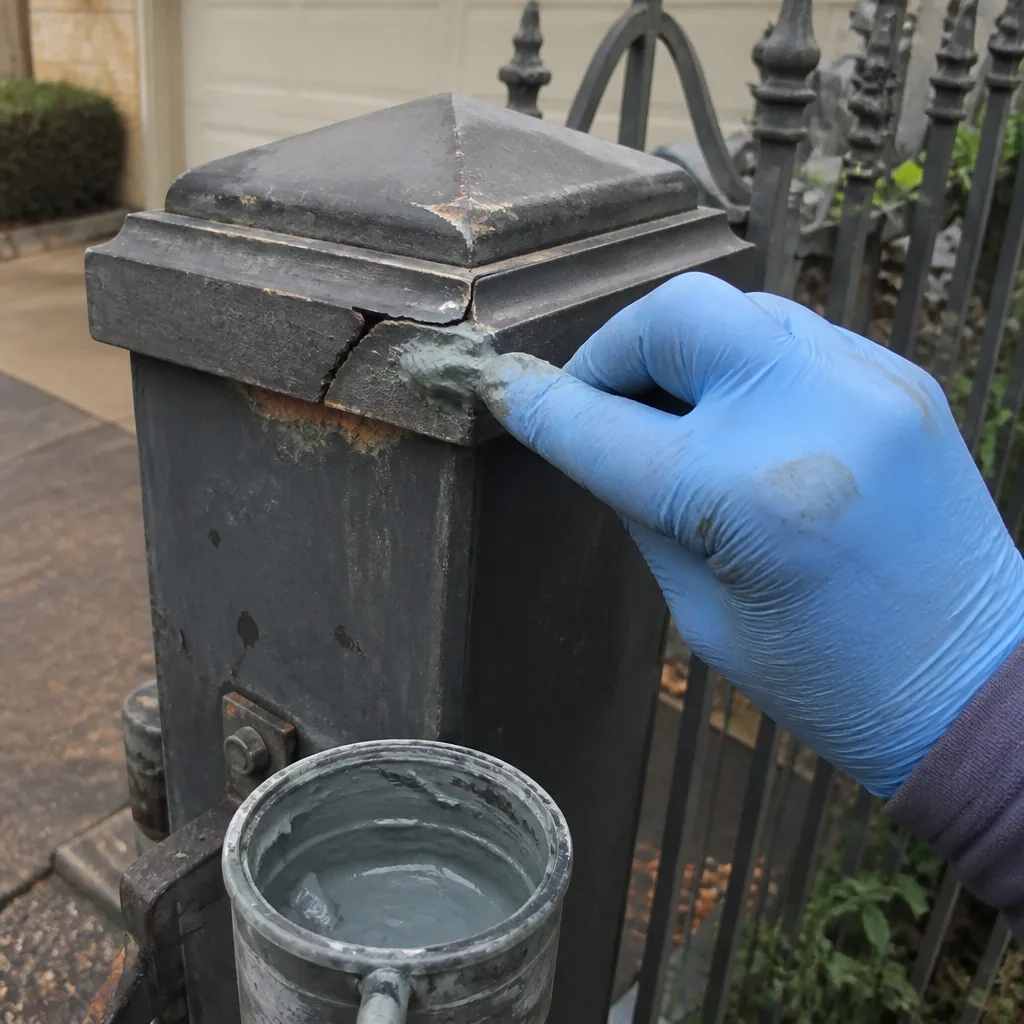
Sugar Land summers are not just hot; they’re punishing for specific gate components in ways that have nothing to do with soil. Three failures dominate our summer service calls, and each one is predictable enough that we can map them to the calendar.
Photo-eye lens degradation. The infrared beam sensors on your gate, commonly called photo-eyes, sit in direct sun for six to eight hours a day from May through September. The polycarbonate lenses are UV-stabilized, but that stabilization degrades over three to five years in this climate. What we see in Sugar Land is not sudden failure; it’s gradual opacity. The lens clouds, the beam weakens, and the gate starts reversing for no reason the homeowner can identify. The fix is a lens replacement or a full photo-eye swap, depending on the brand and housing condition. A $40 photo-eye from a FAAC or BFT system that fails in July will generate a $180 service call because the gate won’t stay closed, and the homeowner assumes the motor is dying.
Battery voltage drop. Most Sugar Land gates with battery backup run sealed lead-acid batteries inside the control box. Heat shortens battery life aggressively. A battery rated for three years in a mild climate will often fail in 18 to 24 months in a Sugar Land summer, because the control box interior regularly exceeds 130 degrees in direct sun. When the battery fails quietly, the gate still works on AC power, but the first power blip knocks out the operator memory. Then the limits reset, the remote codes wipe, and the gate opens halfway and stops. Summer is when we replace the most backup batteries across Sugar Land, and we always photograph the old battery with its date code so the homeowner has a record of when it was installed.
Aluminum track thermal expansion. Aluminum slide-gate track expands when it gets hot. On a 20-foot gate, the track can grow by roughly an eighth of an inch between a 50-degree winter morning and a 105-degree August afternoon. That sounds minor, but if the track was installed tight to its mounting brackets or butted against a concrete curb when it was cool, the expansion has nowhere to go. The track bows slightly, the gate rollers bind, and the motor draws higher current, which trips the obstruction sensing. We see this on slide gates across Sugar Land every summer, particularly on properties where the track faces full west sun in the afternoon. The fix is usually a track-end relief cut or bracket adjustment, not a new motor.
Winter Condensation: Control Boards and the Freeze Windows Sugar Land Gets
Sugar Land does not get a hard winter, but it gets something specific: short freeze windows, typically 36 to 72 hours at a stretch, arriving between late December and mid-February. These windows create the one winter failure pattern we see consistently: condensation inside control boards.
Here’s how it works. The control board lives inside a metal or plastic enclosure mounted near the gate. During a warm, humid day, the enclosure heats and the air inside it holds significant moisture. When a cold front drops the temperature 30 degrees in six hours, that moisture condenses on the circuit board, the terminal strips, and the back of the keypad membrane. If the board is powered, the condensation can cause a short across low-voltage terminals. The symptom is a gate that works fine at noon and then won’t respond at 7 a.m. the next morning, after a cold night.
The prevention is cheap and simple. A desiccant pack, replaced once a year, placed inside the control enclosure absorbs most of the moisture that causes winter condensation failures. A 6-inch pack costs a few dollars and prevents a control board replacement that can run several hundred dollars depending on the brand. The second prevention step is making sure the enclosure drain holes, if the manufacturer included them, are not blocked by dirt or insect nests. The third step is checking that the enclosure gasket seats fully around the wires entering the bottom. A pencil-sized gap is enough to let humid air in constantly.
On residential gates in Sugar Land, we also see winter failures related to limit switches when they have been set at the edge of their travel. Cold temperatures make the aluminum gate structure contract slightly, which effectively changes the travel distance by a fraction of an inch. If the limit switch was already set at the ragged edge of where the gate should stop, that small contraction is enough to cause an over-travel fault. This is another reason the fall calibration window matters: a gate set with a small margin on each limit in October will ride out the winter contraction without tripping.
The Fall Calibration Window: Mid-October to Thanksgiving
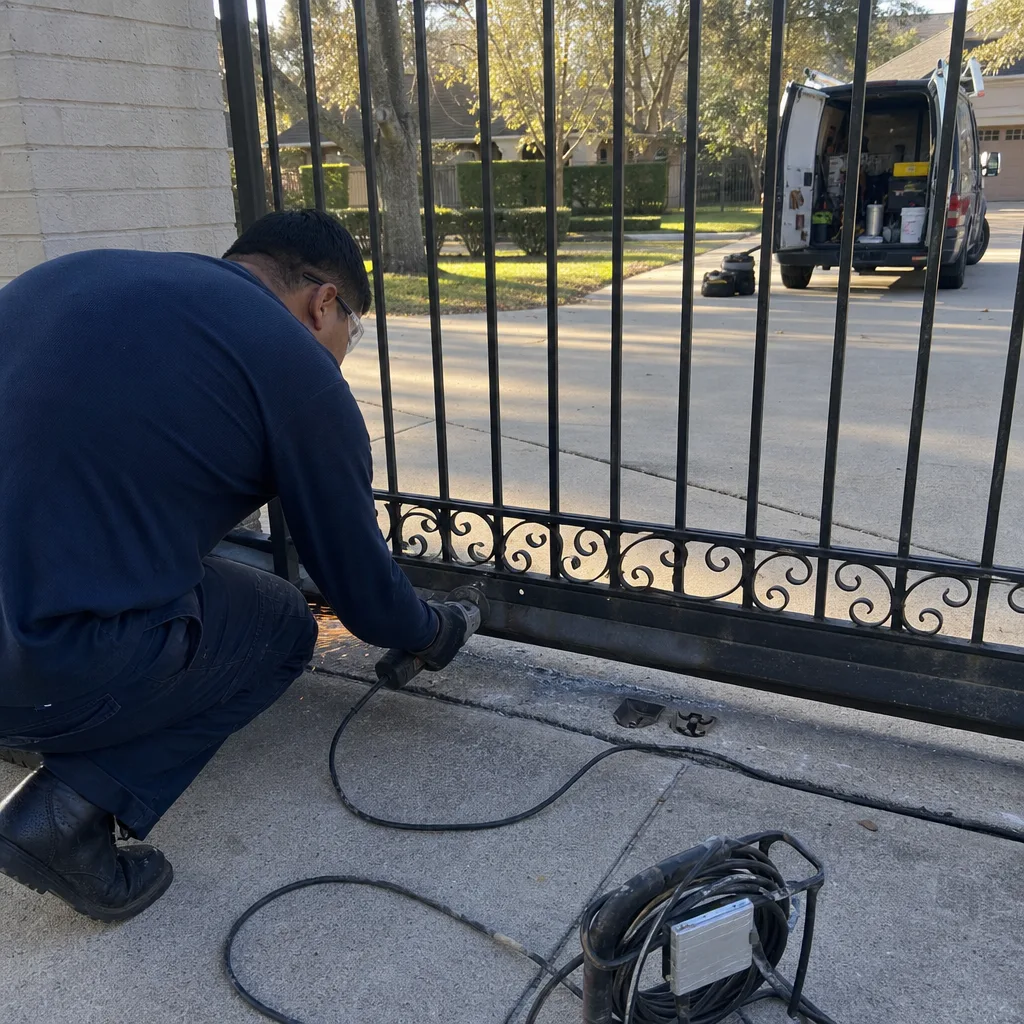
The most important maintenance period for a Sugar Land gate is the six-week stretch from mid-October through Thanksgiving. This is when the soil has rehydrated enough from fall rains to stop shrinking, but has not yet swelled to its winter maximum. The gate geometry is, for this brief window, closest to a true neutral.
Calibration work done during this window holds. We set limit switches, photo-eye alignment, and latch positioning in a soil condition that represents the midpoint between the summer shrink extreme and the winter swell extreme. The gate will drift slightly in both directions over the next six months, but it will stay within its component tolerances because the calibration point was chosen from the middle, not from an edge.
Here is the fall calibration sequence we run on a typical Sugar Land swing gate:
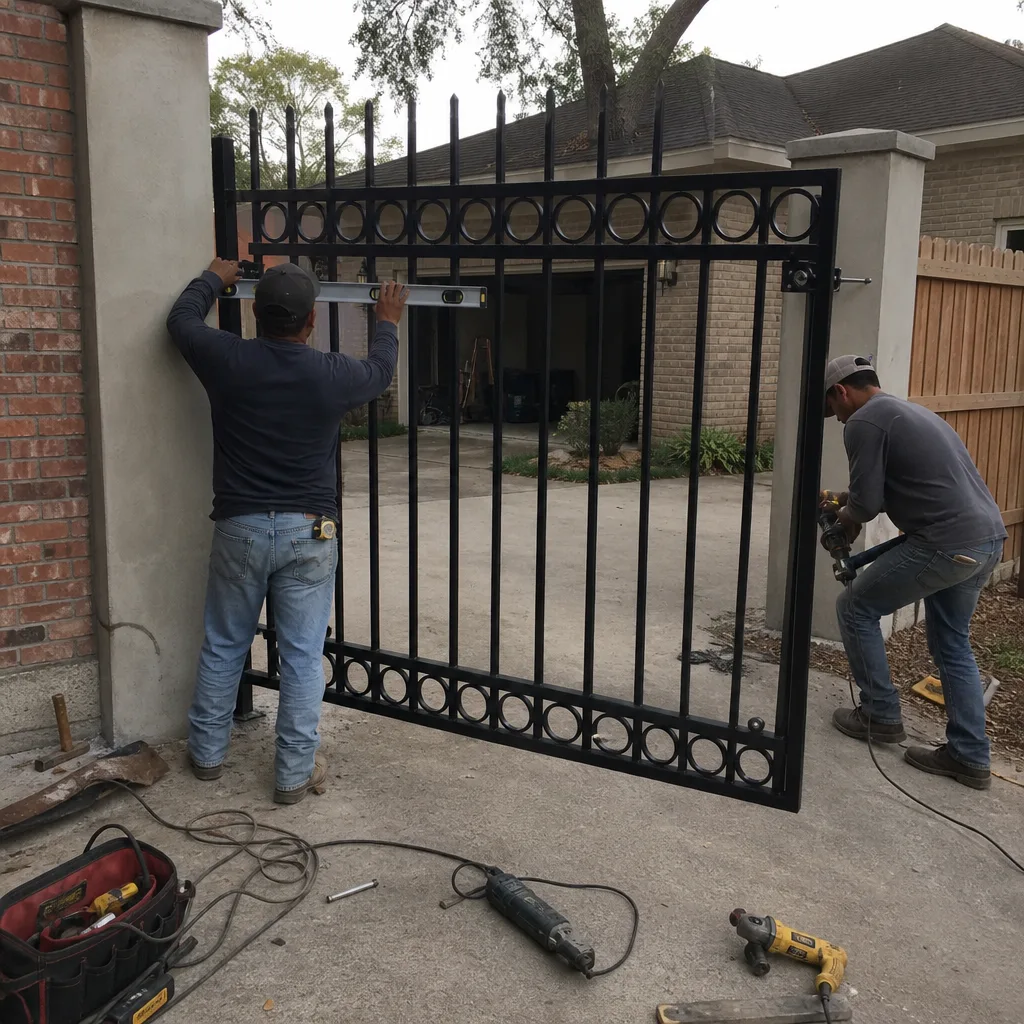
- Post lean check. We use a four-foot digital level against each gate post and record the deviation in both axes. The number gets written down, not just eyeballed, so the spring visit can compare it.
- Limit-switch verification. We run the gate through a full open and close cycle and verify that the limit settings leave a small margin on both ends of travel. If the gate travels to within a quarter-inch of hard stops, we reset the limits with more margin.
- Photo-eye alignment. We align the beam, then intentionally block it to verify the gate reverses. We also clean the lenses with a plastic-safe cleaner and record the condition on the photo log.
- Battery test. We load-test the backup battery to confirm it holds voltage under draw. If it fails, we replace it and record the new battery’s date code.
- Latch and strike alignment. We adjust the mechanical latch so it engages cleanly without dragging, then photograph the closed position for the record.
- Documentation. Every reading, every adjustment, every part number goes into a written report you keep. Under Clause 4 of the Haven Standard, every visit includes a documented photo record at no additional charge.
This sequence is what our Gate Motor & Opener in Sugar Land service performs during the fall window, and it is the single highest-value maintenance visit a homeowner can schedule in this climate.
The Spring Window: Late February Through Early April
The second maintenance window runs from late February through early April. By this point, the clay soil has reached its near-maximum swell, the winter condensation cycle has done its worst, and the gate has spent two months operating in its most shifted geometry. The spring visit is not a duplicate of the fall visit. It serves a different purpose: damage assessment and moisture-related cleanup.
During the spring window, we look for the specific things winter left behind. We check for corrosion on terminal connections inside the control box, evidence of condensation residue on the board, desiccant-pack saturation, and any insect or rodent activity inside the enclosure. We also re-verify post lean, because the swollen soil has now pushed the posts to their opposite extreme, and we want to record that number for the drift profile.
A spring visit is also the right time to address any over-travel faults that appeared during the winter contraction. If the gate thumped hard against its stop in January, we’ll see the evidence in March as a slightly bent limit bracket or a scored track. Catching that in early spring means a small repair instead of a motor replacement later.
For homeowners who missed the fall window, the spring window is the fallback. Calibration work done in late February holds reasonably well through the spring and into early summer, though it will need a touch-up the following fall because the shrink cycle will pull it slightly out of alignment again. Better to catch the fall window; acceptable to use the spring window if you missed it.
Building a Drift Profile: Documenting Seasonal Readings by Month
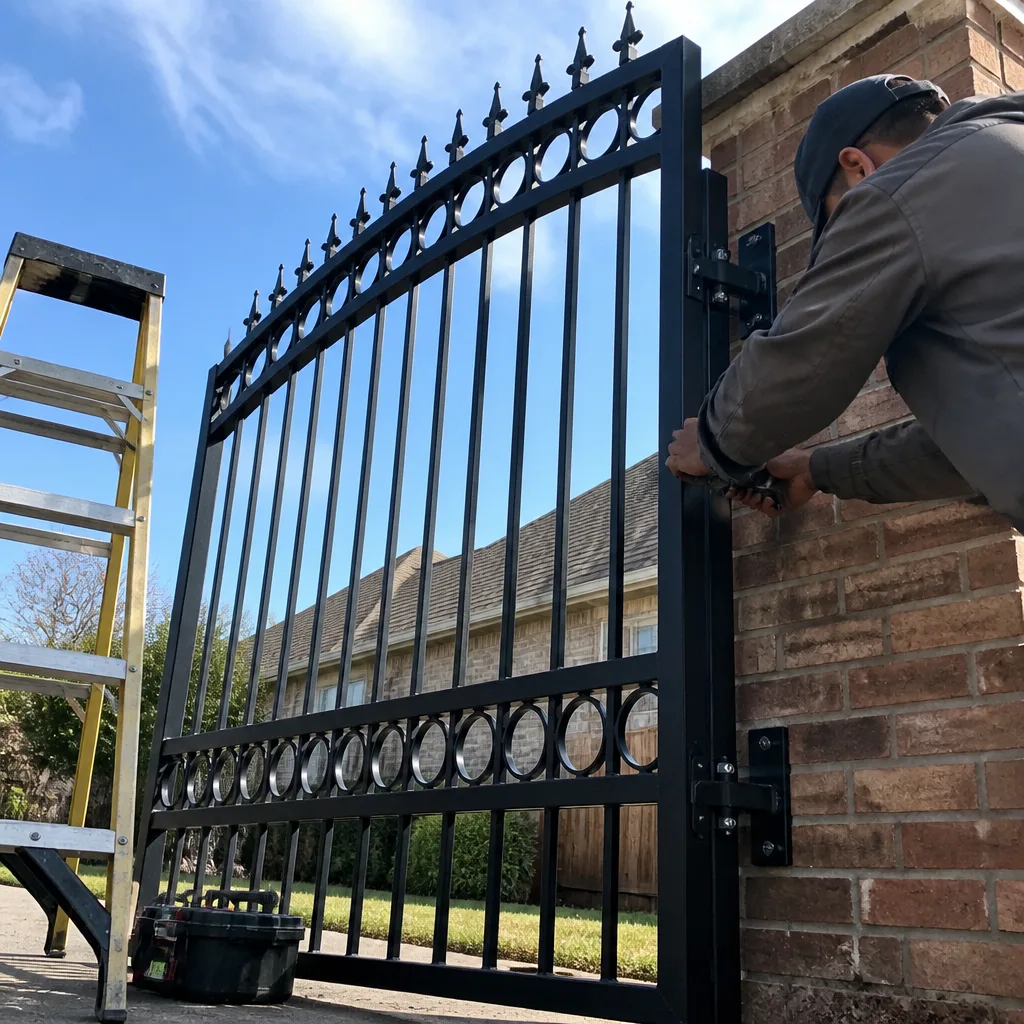
Here is the thing most gate companies won’t tell Sugar Land homeowners: your gate has a specific drift signature that is unique to your property. The depth of your post footers, the soil composition at your exact address, the drainage pattern around your driveway, the weight of your gate leaf, and the brand of your operator all combine to create a predictable pattern of movement. Once you have two years of readings, you can anticipate failures before they happen.
We build drift profiles for every gate we service in Sugar Land. The process is simple. Twice a year, during the two calibration windows, we record three numbers: post lean in degrees on the hinge post, post lean in degrees on the latch post, and limit-switch travel in inches of overrun or underrun at the closed position. Each number goes into a dated record alongside a photo of the gate in its closed position.
After two years, the numbers tell a story. A gate with stable posts but drifting limits points to a motor or gearbox issue. A gate with stable limits but drifting posts points to a footer problem that calibration alone will never fix. A gate where both drift together in the same direction each summer points to a soil issue that may require a deeper footer or a different post-mounting strategy.
Here is what a typical two-year drift profile looks like for a Sugar Land swing gate set in a 36-inch footer on expansive clay:
- October 2024: Hinge post lean 0.4°, latch post lean 0.3°, limit travel at 100% of set range.
- February 2025: Hinge post lean 0.6°, latch post lean 0.1°, limit travel at 103% (mild overrun from winter contraction).
- October 2025: Hinge post lean 0.3°, latch post lean 0.4°, limit travel at 99%.
- February 2026: Hinge post lean 0.5°, latch post lean 0.2°, limit travel at 101%.
Those numbers tell us the posts are moving within a tolerable range, the footer is adequate, and the winter overrun issue is minor. We might recommend a small limit adjustment and nothing more. Compare that to a gate where the hinge post lean climbs from 0.4° to 1.2° in one year. That is a footer that is failing, and no amount of limit-switch work will compensate for it.
The drift profile is part of what you get when you work with our Vance Gate Repair Sugar Land home team. We don’t treat every visit as an isolated event. We treat it as a data point in a long record that tells us exactly what your gate is doing and why.
Brand-Specific Seasonal Notes: FAAC, BFT, and Linear
Sugar Land gates run on a mix of operator brands, and each has a few seasonal quirks worth knowing. We service nine major gate-automation brands, so we see the failure patterns side by side and can speak to which ones tolerate this climate better than others.
FAAC operators are common on higher-end Sugar Land swing gates. The FAAC hydraulic and electromechanical operators are generally robust in heat, but the limit-switch housing on older FAAC models is prone to moisture intrusion during the winter condensation windows. If you have a FAAC that starts faulting only on cold mornings, the first thing to check is the limit enclosure for condensation residue. On the plus side, FAAC’s photo-eye systems tend to handle UV exposure better than most, so summer lens clouding is less common on FAAC gates than on some other brands.
BFT operators appear frequently on Italian-imported gates throughout Sugar Land’s newer subdivisions. BFT control boards are more sensitive to voltage fluctuation than most, which makes them vulnerable to the summer thunderstorm season when power flickers are common. A BFT gate that loses its memory after every storm likely needs a new backup battery, because the board relies on that battery to hold settings through brief power interruptions. The winter condensation pattern also applies, and BFT boards have exposed terminal strips that corrode faster than sealed units from other brands.
Linear operators dominate the mid-range residential market in Sugar Land, and their primary seasonal weakness is the plastic gear inside many Linear swing and slide operators. Heat accelerates plastic gear wear, and a Linear operator that runs smoothly in January may start slipping in August because the gear teeth have softened and stripped under load. If your Linear gate starts moving unevenly or hesitating in summer, the gear is the prime suspect, and it is a relatively inexpensive repair compared to a full operator replacement.
We also work on Viking operators, which are common on larger custom gates in Sugar Land’s estate neighborhoods. Viking equipment is built heavier than most residential brands and handles the heat well, but the sheer weight of Viking gates means soil movement has an outsized effect on component wear. A Viking gate on a post that leans half a degree will translate that movement into higher wear on the hinge bearings and operator arm.
Whatever brand is on your property, the seasonal patterns hold. Heat accelerates component wear. Condensation attacks electronics. Soil movement shifts geometry. The brand determines which symptom appears first, but the underlying causes are the same across every gate in Fort Bend County.
If you’re considering a brand change or a full gate replacement, our Gate Installation in Sugar Land service can walk you through which operator matches your gate’s weight, usage, and sun exposure.
Common Mistakes to Avoid
- Calibrating in August. Sugar Land homeowners often schedule gate work when the problem feels worst, which is late summer after the soil has shrunk to its maximum. Fixing a gate in August means fixing it against a post position that will change within 60 days. You’ll pay for the same repair again in October.
- Ignoring a reversing gate. A gate that reverses mid-cycle is usually not a motor problem. It’s a photo-eye alignment issue or a limit-setting issue. Chasing the motor without checking the sensors wastes money and leaves the real problem in place.
- Replacing the operator before checking the battery. Summer heat kills backup batteries, and a dead battery triggers symptoms that look like operator failure: lost limits, wiped remote codes, partial opening. A battery replacement is a fraction of the cost of a new operator.
- Skipping the condensation prevention. A desiccant pack costs a few dollars. A control board replacement costs hundreds. The math is simple, but most Sugar Land homeowners never know the desiccant pack exists until they’re paying for the board.
- Ignoring post lean because the gate still works. You won’t see a half-degree of post lean from the curb, but your gate feels it every cycle. Once the lean passes about one degree, component wear accelerates quickly. Catching it early means a shim or brace adjustment; catching it late can mean footer work.
- Not keeping the paperwork. If you don’t have a record of what was adjusted and when, the next technician starts from zero. You pay for the diagnosis again. A documented record, like the one our service leaves on every visit, means the next repair starts from known data.
- Waiting until the gate stops completely. Most Sugar Land gates give warning signs for weeks or months before they fail: a slower travel time, a new grinding sound, a gate that reverses once a week. Addressing the warning costs less than addressing the failure.
When to Call a Professional
Some gate work is genuinely dangerous for a homeowner to attempt. High-tension springs, heavy gate leaves, and live electrical connections can cause serious injury. If your gate has a broken torsion spring, a snapped cable, a motor that sparks or smokes, or a gate leaf that has come off its track, do not try to fix it yourself. Call a professional who is trained to handle the load and the tension safely.
You should also call a professional when the problem involves limit-switch calibration or control-board work. These systems carry live voltage even when the gate appears off, and setting limits incorrectly can cause the gate to over-travel and damage itself. Vance Gate Repair Sugar Land offers free estimates in Sugar Land, and a live person answers the phone 24/7. Call (346) 295-3437 if your gate is binding, reversing, or failing to hold its settings.
Frequently Asked Questions
A Sugar Land gate should be serviced twice a year, once during the fall calibration window (mid-October through Thanksgiving) and once during the spring window (late February through early April). These two visits catch the soil-movement issues before they become failures and keep your gate’s drift profile current.
Your gate binds in winter because Fort Bend County’s clay soil swells when wet, shifting the gate posts and changing the gate’s geometry. A gate calibrated during the dry summer months will bind when the soil expands and the posts move. The fix is to recalibrate during the fall window when the soil is at its neutral midpoint.
Seasonal gate maintenance in Sugar Land typically runs between $120 and $250 per visit, depending on the gate type, the operator brand, and whether any parts need replacement. The initial visit includes the full inspection, calibration, and documentation, and you get the written price before any work begins.
A reversing gate is usually caused by a misaligned photo-eye or an incorrectly set limit switch. You can check and clean the photo-eye lenses yourself, but limit-switch adjustment involves live electrical components and should be handled by a trained technician. Call (346) 295-3437 for an exact diagnosis, and the estimate is free.
The best month to install a new gate in Sugar Land is October, because the soil is at its most stable and the gate can be set and calibrated at the neutral midpoint. Installations done during the summer shrink cycle or the winter swell cycle often require re-adjustment within a few months.
We service nine major gate-automation brands, including FAAC, BFT, Linear, and Viking. We work on whatever operator is already on your property rather than steering you toward a replacement. Call (346) 295-3437 and tell us what brand you have, and we’ll confirm the right service for it.
The Bottom Line
Your Sugar Land gate is not failing randomly. It is responding to predictable seasonal forces: clay soil that shrinks in summer and swells in winter, heat that degrades components and shortens battery life, and condensation that attacks control boards during brief freeze windows. The solution is not to fix problems as they appear. The solution is to calibrate on schedule, during the two windows when the soil is stable, and to keep a documented record of every reading so you can see problems forming before they break anything. Mid-October through Thanksgiving is the single most important maintenance period on the Sugar Land calendar. Miss it, and you will likely pay for the same work again in the spring.
Call Vance Gate Repair Sugar Land at (346) 295-3437 for a free estimate. You’ll get a written price before any work begins, a photographed record of everything we find and adjust, and a service record that stays with your gate for as long as you own it.
Written by Adrian Vance, Owner at Vance Gate Repair Sugar Land, serving Sugar Land since 2014.