
Last updated September 20, 2026
Free on-site gate assessment - hinges, posts, and your LiftMaster or Nice gate operator checked before anything is quoted
The assessment is free and the quote is the invoice.

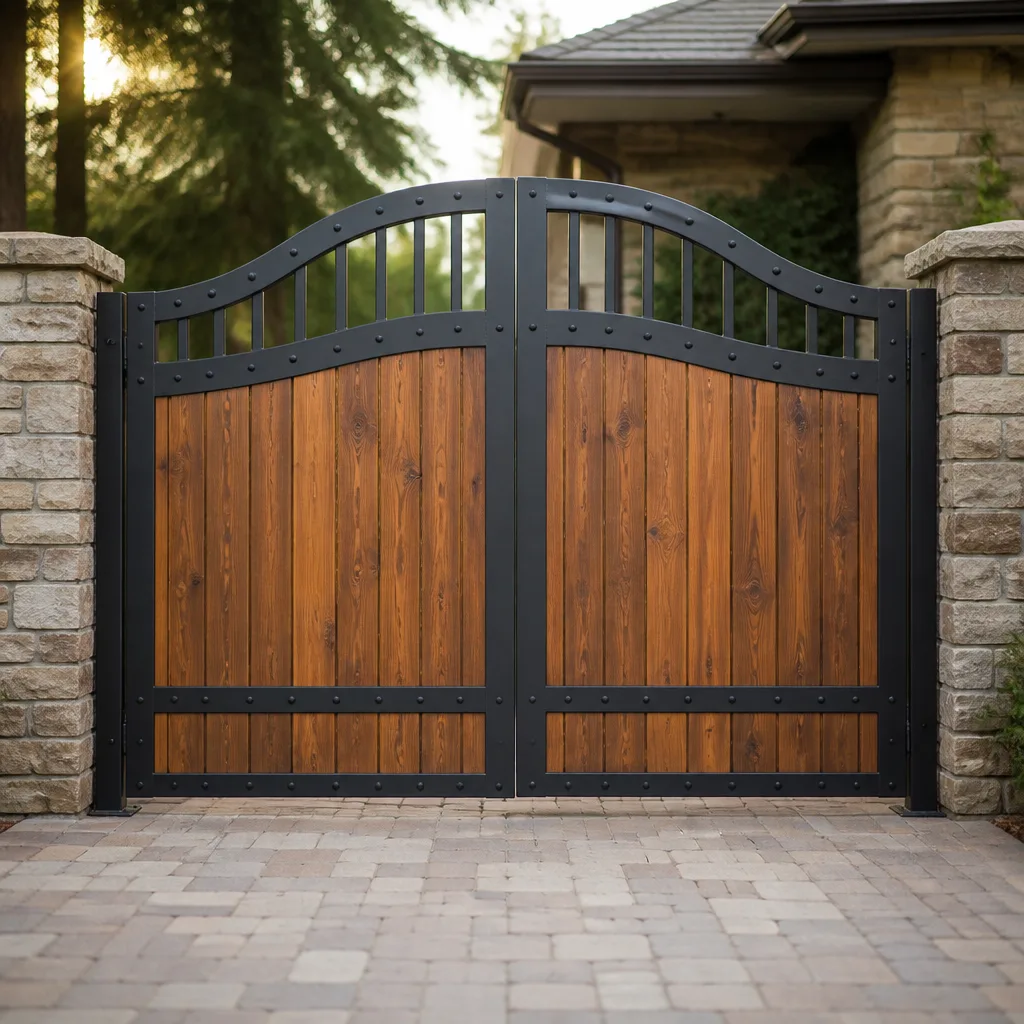
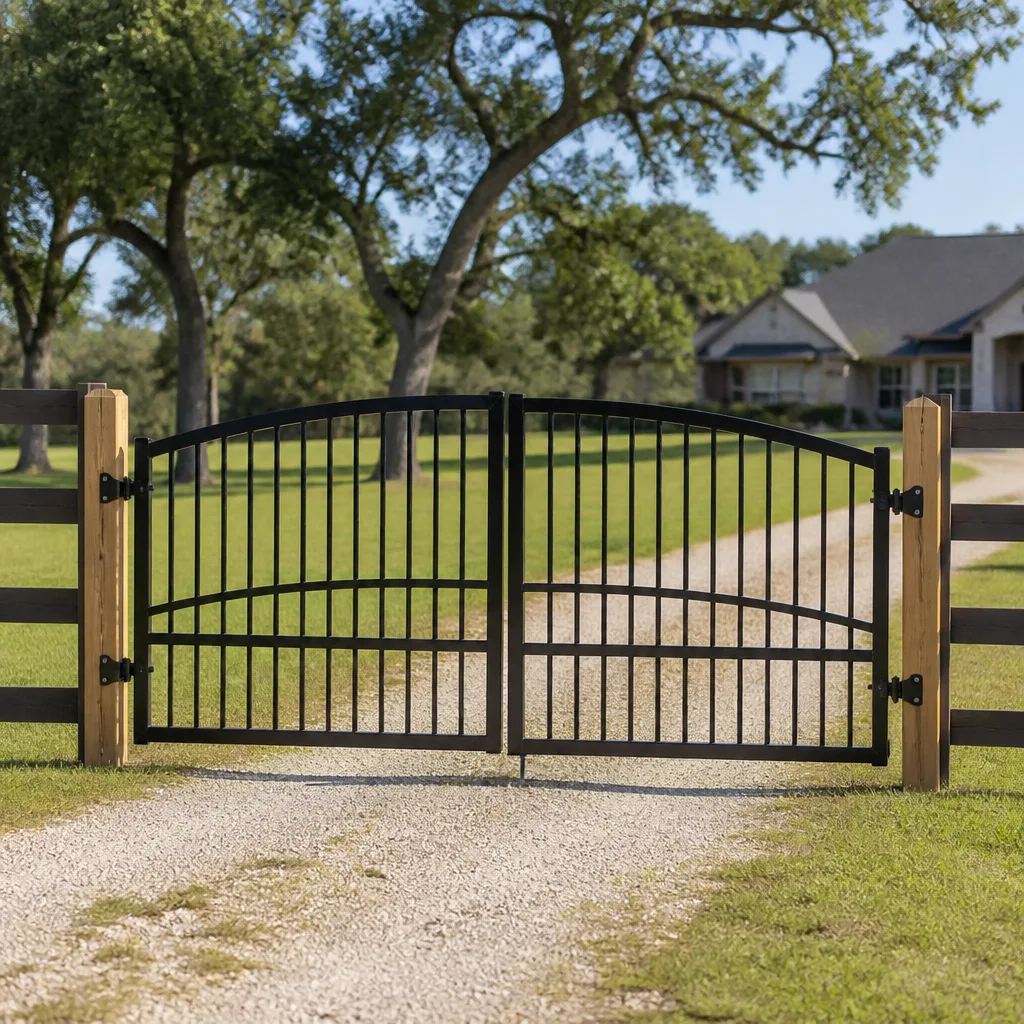
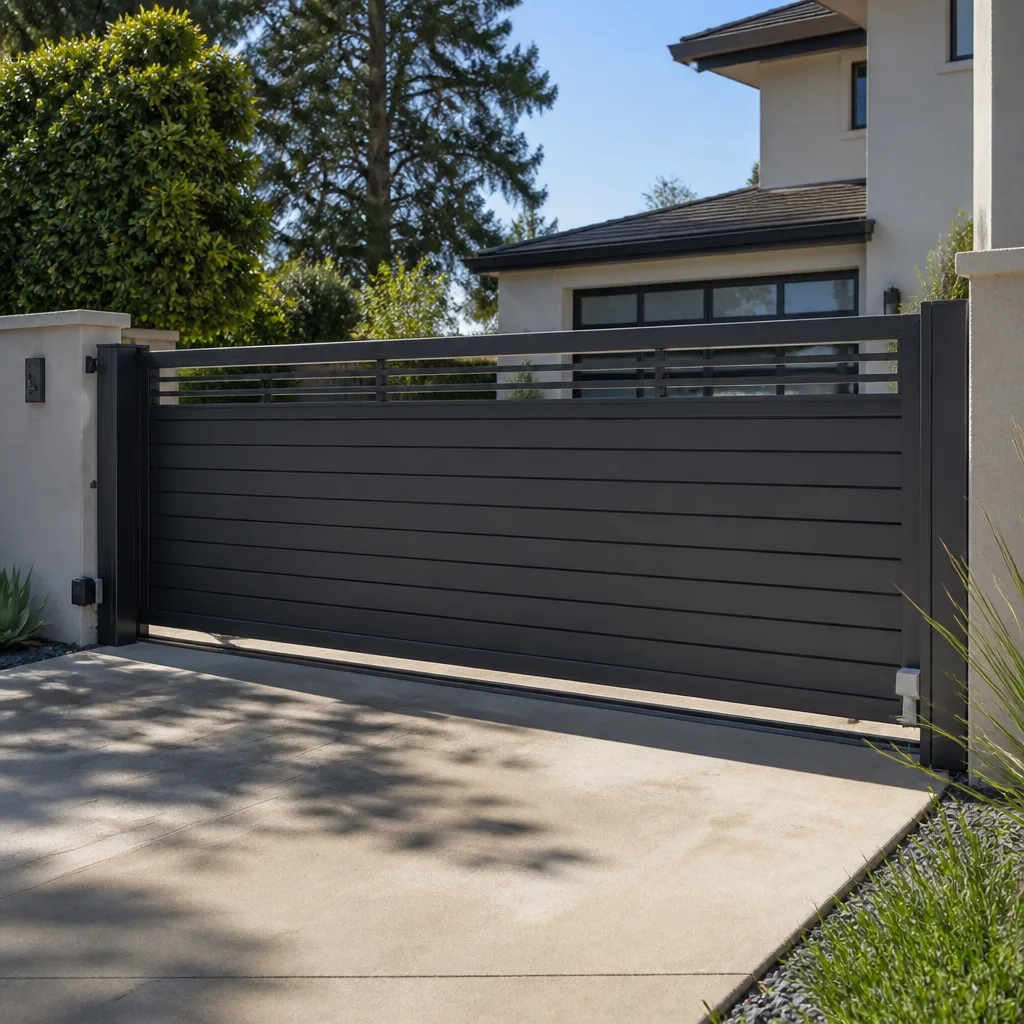
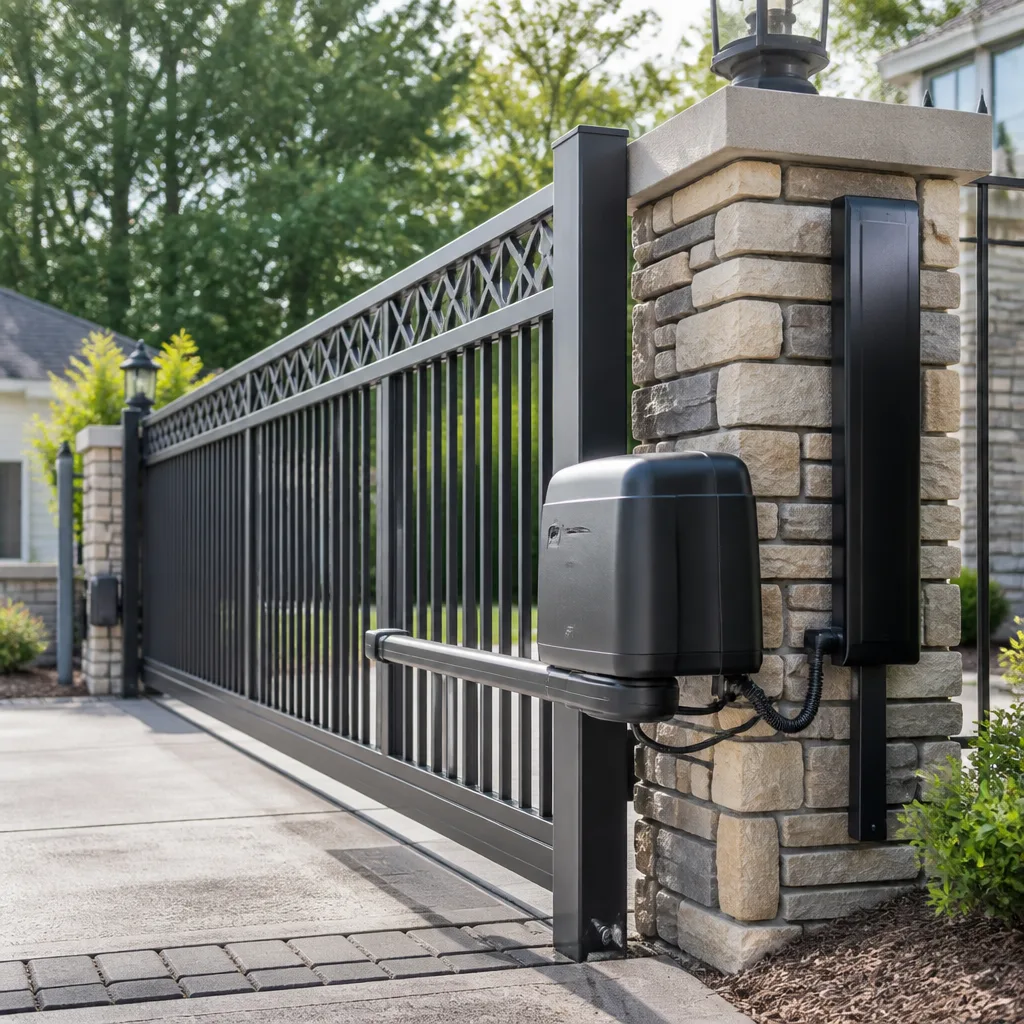
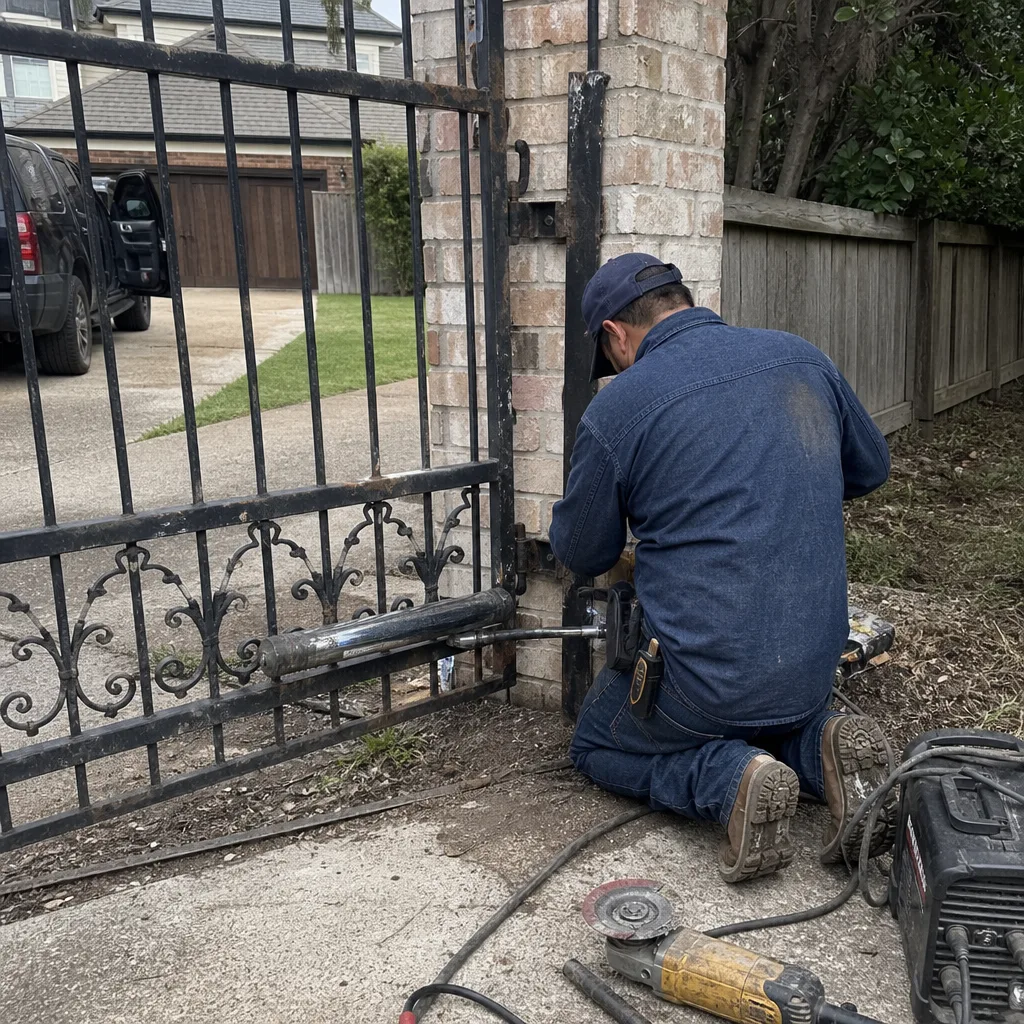 Before
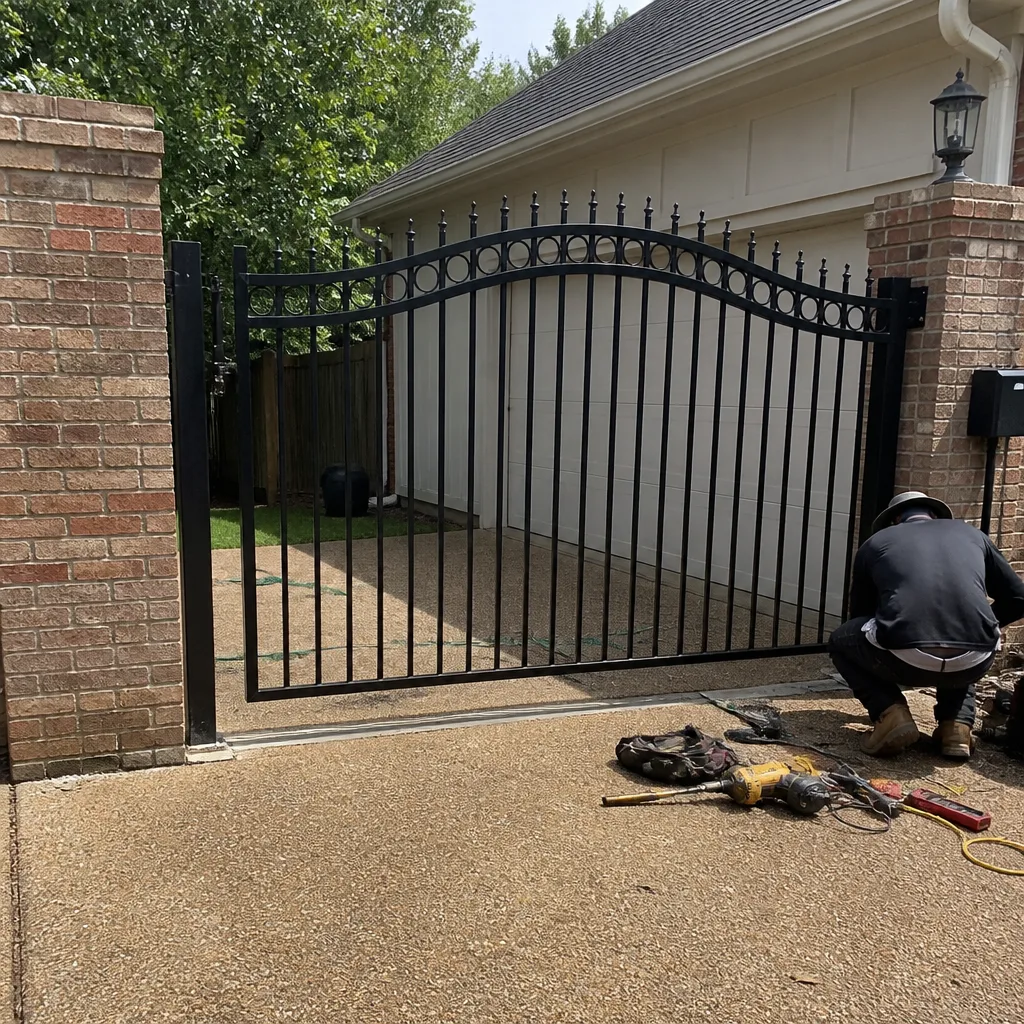 After
After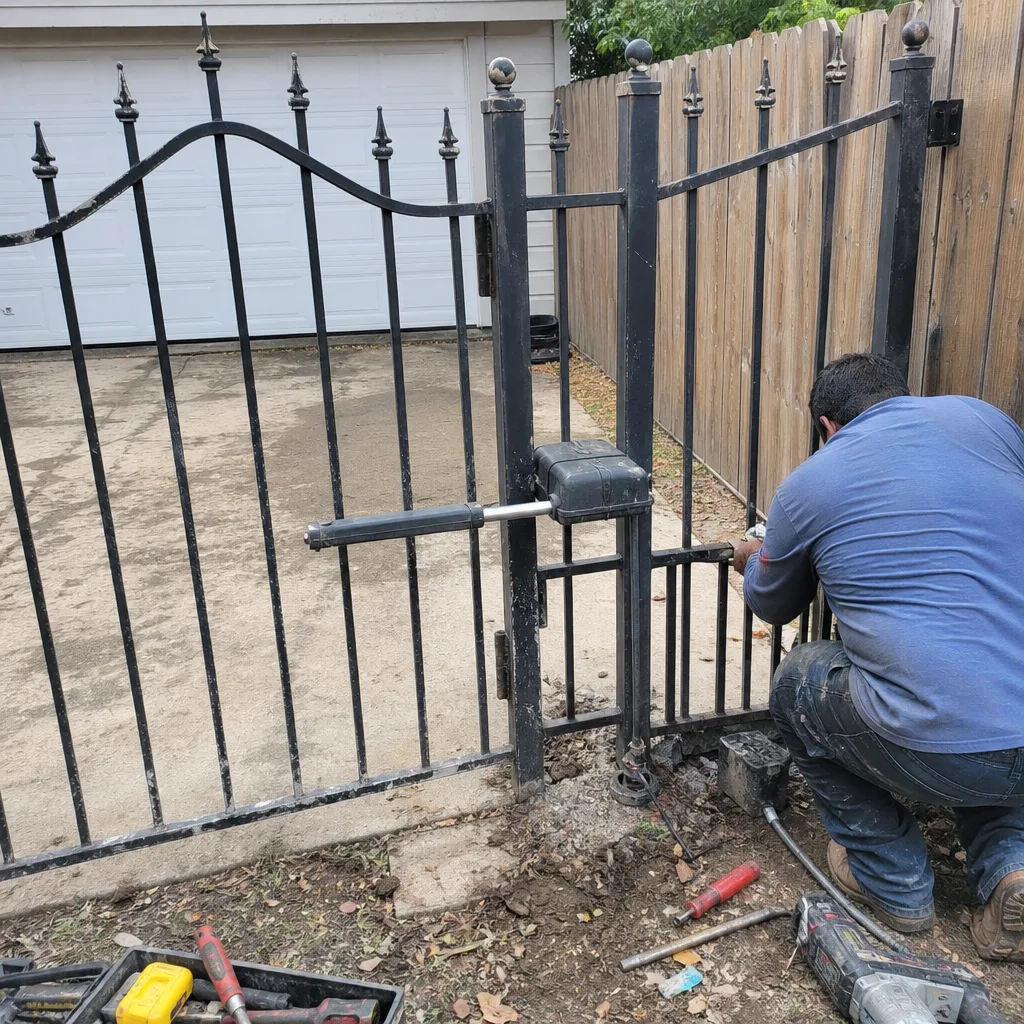 Before
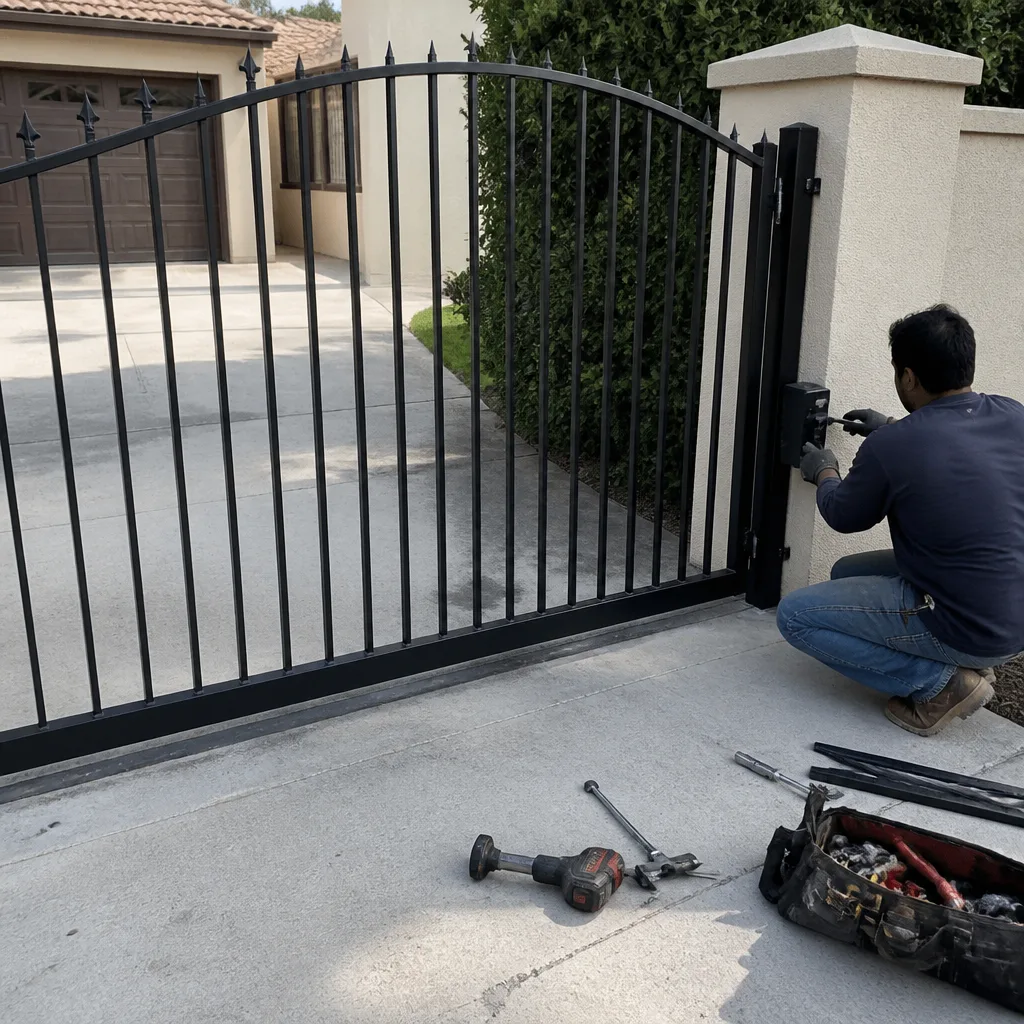 After
After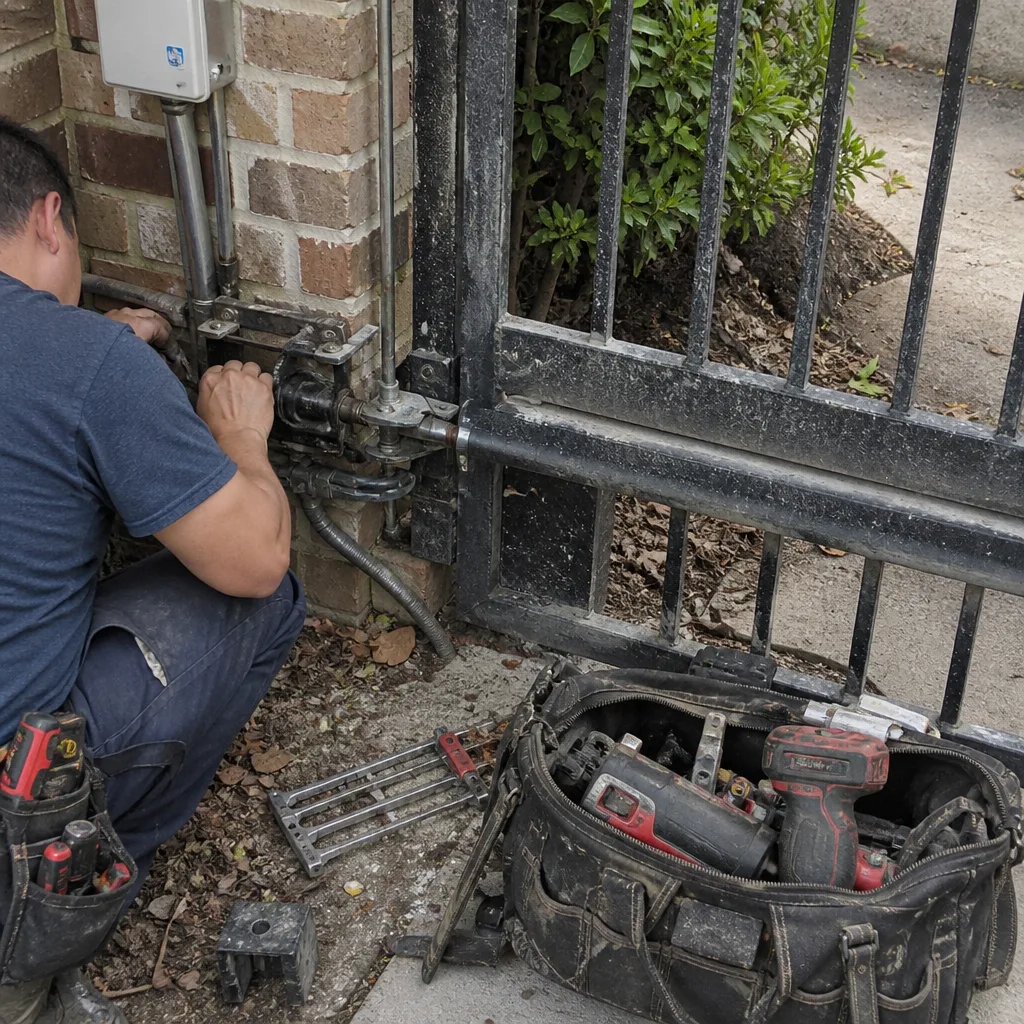 Before
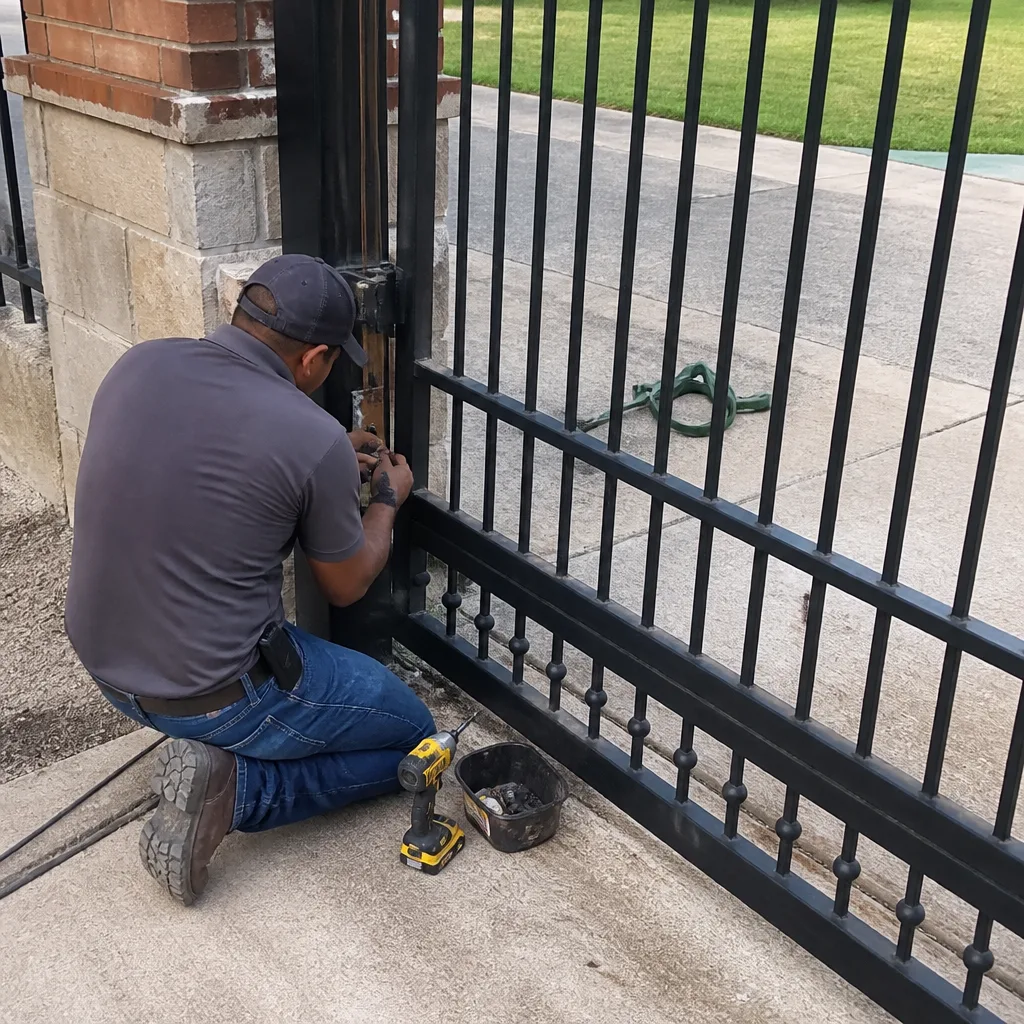 After
AfterGate Repair Maintenance Checklist for Sugar Land Homeowners
Most Sugar Land gate failures don’t start with a sudden snap or a collapsed hinge. They start with a number that slowly drifts: a close cycle that takes 15 seconds instead of 11, a current draw that climbs from 9 amps to 13 before the motor thermal-limits and stops mid-travel. A gate that “opens smoothly” is an opinion. A gate that opens in 9.3 seconds, with a close torque of 14 inch-pounds, is a data point you can compare against next quarter. This guide gives Sugar Land homeowners a maintenance checklist built around that principle: every item produces a number to record, not just a box to check. By the end, you’ll have a complete inspection routine and a log format that tells any future technician exactly what your gate looked like, sounded like, and drew electrically before the problem ever showed up at the driveway.
Quick Answer
A gate maintenance checklist for Sugar Land homeowners should include monthly debris and hinge inspection, quarterly lubrication and photo-eye alignment checks, and a twice-yearly full system test that records cycle time, close force, and battery voltage. The most important habit is writing down those measurements on a consistent schedule so drift is detectable before failure. If anything reads outside the baseline range you established, call our Gate Repair services before the component fails completely.
Table of Contents
- Why Numbers Beat Checkboxes: The Measurement-First Philosophy
- The Monthly Checklist: 15 Minutes at the Driveway
- The Quarterly Checklist: Lubrication, Alignment, and Photographs
- The Twice-Yearly Deep Inspection: Electrical Readings and Baseline Drift
- What Sugar Land’s Climate Accelerates: Humidity, Standing Water, and Ground-Level Weld Seams
- Owner-Serviceable vs. Technician-Only: Where the Line Is
- Photographic Baseline: How to Document Gate Geometry
- The Maintenance Log Template: Two Minutes for the Next Technician
- Common Mistakes to Avoid
- When to Call a Professional
- Frequently Asked Questions
- The Bottom Line
BeforeAfterWhy Numbers Beat Checkboxes: The Measurement-First Philosophy
A checkbox tells you a thing was looked at. A number tells you whether that thing changed. The distinction matters more for gates than most equipment because gate failures are almost always gradual: a gear wears, a limit switch drifts, a capacitor loses capacity, a hinge settles. None of those announce themselves. They accumulate. When a Sugar Land homeowner writes “gate checked, OK” for sixteen months, they have no record of anything except that someone glanced at it. When that same homeowner writes “cycle time 11.2s, close torque 14 in-lb, battery 26.4V” every six months, they have a trend line. The first time the cycle time jumps to 14 seconds, they don’t have to guess whether the motor is tired. The log says so.
This is the same habit Adrian Vance developed working on commercial access-control systems starting in 2014, where a gate failing to close is not an inconvenience but a documented security event. On those sites, technicians log limit-switch positions, force readings, and photo-eye alignment at every service visit because the next technician needs a reference point. We adapted that habit for residential work under what Vance Gate Repair Sugar Land home calls the Haven Standard: written documentation on every job, not just the complicated ones. Your maintenance log is the homeowner version of that same principle. It takes sixty extra seconds at each inspection and saves hundreds of dollars in diagnostic time later.
The numbers that matter for most gates fall into five categories:
- Cycle time: how long the gate takes to open fully and close fully, measured with a stopwatch or phone timer.
- Close force or torque: the resistance the motor overcomes during the close direction, read from the operator’s display or set via the limit adjustment on legacy systems.
- Current draw: amperage during operation, if your operator has a diagnostic display or you have a clamp meter on the battery circuit.
- Battery voltage: for gate operators with battery backup, the resting voltage and the voltage under load.
- Geometry measurements: ground clearance at both ends, gap between gate leaf and post, plumb of the posts, measured with a tape measure and a level.
Each of these has a normal range for your specific gate. The first time you record them, you’re establishing a baseline. Every subsequent measurement is compared to that baseline. A number that moves more than ten to fifteen percent in either direction is your early-warning signal. For Sugar Land homeowners, this habit matters more than average because the coastal humidity accelerates the underlying mechanical changes. The faster you catch drift, the cheaper the fix.
The Monthly Checklist: 15 Minutes at the Driveway
The monthly check is fast because it’s mostly visual. You’re not adjusting anything; you’re looking for what moved, what accumulated, and what’s touching that shouldn’t be. Sugar Land’s growing season means vegetation can encroach a gate track within weeks, especially after a wet spell. The monthly visit is when you catch that before it turns into a binding load on the motor.
- Clear the track and wheels (slide gates). Remove leaves, twigs, mud, and gravel from the track channel and from inside the wheel housings. On a V-track slide gate, debris packed into the V-groove acts as a wedge that forces the gate upward and outward. Record whether you found debris on the track and where it accumulated. After months of noting “leaves at the north end,” you’ll know where to focus.
- Check the gate’s travel path (swing gates). Watch the gate open and close from the side. Note whether either leaf scrapes the driveway at any point or whether the gap between the leaves changes through the arc. A leaf that clears the driveway by two inches at the start of the swing but touches at the end indicates a hinge issue, not a ground-level rise.
- Inspect both photo-eyes. Clean the lens face on each photo-eye with a dry cloth. In Sugar Land’s humidity, a thin film of condensation mixed with dust can reduce the beam’s effective range enough to cause intermittent reversing behavior. Align the eyes visually and record whether either lens showed visible moisture.
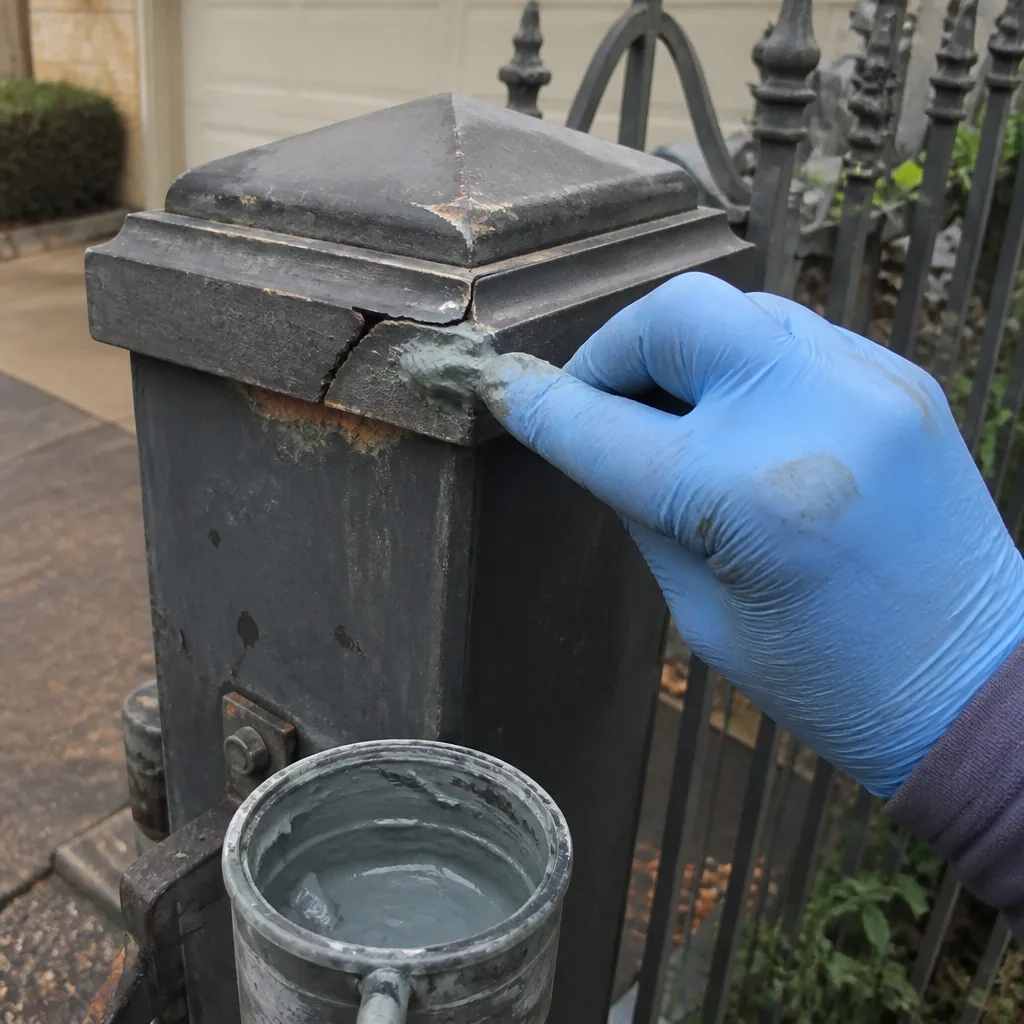
- Look for rust or paint blisters on all metal surfaces. Start at the bottom. Concentrate your inspection on the bottom six inches of every metal post, the hinge barrels, and the ground-level weld seams. These are the first places Sugar Land standing water and humidity attack. Record the location of any rust spots you find, not just their existence. “Rust on lower hinge bracket, interior side, quarter-inch diameter” is a useful entry. “Some rust” is not.
- Operate the gate three full cycles. Listen. A new sound, a change in sound, or a pause mid-cycle means something is binding, or a capacitor is weak, or a gear stage is wearing. Record cycle time with a stopwatch each month. If the time changes by more than two seconds without explanation, investigate before the next month’s check.
This entire routine takes about fifteen minutes once you know your gate, and you’ll find more guides & resources to help you get started. The data you record has immediate value: if you call a gate technician for any reason, those monthly entries tell them what changed and when. That skips the most expensive part of gate diagnosis, which is not the repair itself but the time spent establishing what normal looked like before the problem started.
The Quarterly Checklist: Lubrication, Alignment, and Photographs
Every three months, add lubrication and documentation to the monthly routine. Lubrication is the single highest-leverage maintenance action a homeowner can perform, and it’s also the one most often done wrong. Too little lubricant lets wear accumulate. Too much attracts dirt and creates an abrasive paste. The right amount depends on the material and the motion.
What to Lubricate
- Hinge pins and barrels on swing gates: one or two drops of a lithium-based or synthetic hinge lubricant per pivot point. Work the gate back and forth twice to distribute it. Wipe off any excess. If a hinge has a grease fitting, a small shot from a grease gun until you see a slight bead at the seal is sufficient.
- Wheel bearings on slide gates: only if the bearings are accessible and the manufacturer specifies periodic greasing. Sealed bearings need nothing. Unsealed bearings need a light touch. Over-greasing a slide gate wheel pushes grease past the seal and onto the track, where it collects sand and grit.
- The operator’s chain or belt drive: on chain-drive slide gate operators, a light application of chain lubricant every six months is usually enough. On belt-drive systems, no lubrication at all. Belt dressing is not a substitute for proper tension.
- The track itself: never lubricate the track on a slide gate. The wheels roll on it; they don’t slide. Oil or grease on the track reduces traction and collects dirt. Keep it clean and dry.
Quarterly Alignment Checks
Photo-eye alignment drifts gradually as posts settle, brackets loosen, or kids bump into the housings. The quarterly check takes two minutes. Verify that each photo-eye is mounted at the same height, facing its opposite number squarely, with the lens surfaces clean and parallel. On most systems, the receiving eye has an indicator LED that confirms alignment; check the operator manual for your specific brand. FAAC and BFT operators commonly show alignment status on the control-board LEDs, which is worth learning because it’s faster than crawling under the gate. Record whether the LED showed a clean signal or whether you made an adjustment.
Quarterly Photograph Set
Take four photographs from the same positions every quarter:
- Full gate face from the driveway side: shows overall leaf alignment, gap uniformity, and surface condition.
- Both hinges from six inches away: shows rust progression, fastener position, and any movement in the bracket.
- Ground clearance at the latch end of each leaf: use a consistent camera angle so the gap is comparable between photos.
- The operator and its immediate surroundings: shows the motor housing condition, any water staining, and wire entry points.
Store these in a folder on your phone named by date. Six quarters from now, you’ll have a time-lapse of your gate’s geometry. That’s the visual equivalent of the measurement log, and it’s the same documentation habit that runs through every Gate Repair in Sugar Land job we do.
The Twice-Yearly Deep Inspection: Electrical Readings and Baseline Drift
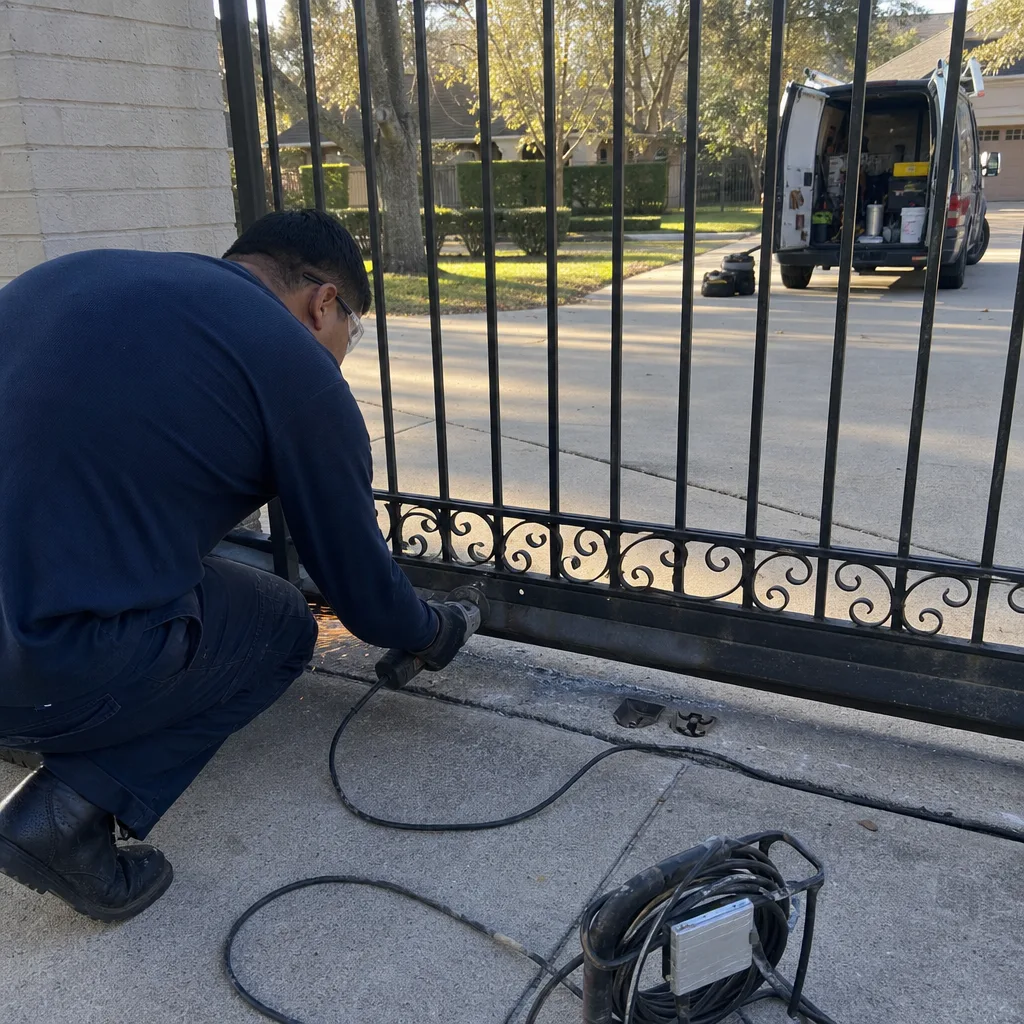
Twice a year, in roughly April and October for Sugar Land’s climate pattern, do a full-system check that includes electrical readings and limit-switch verification. April catches winter damage before the summer heat cycle. October catches summer heat and humidity damage before the cooler damp season. This is also when you re-measure every baseline number from your first inspection and compare.
Cycle time measurement. Time the full open cycle and the full close cycle separately. A gate that opens in the same time it always has but closes slower is showing you resistance on the close stroke. The most common causes are a partially obstructed track, a failing capacitor, or a limit switch that allowed travel to extend, binding against the close stop. Slow close is always worth investigating because the close direction is where the safety systems operate; a motor straining at the close stop is a motor that may overheat or trip.
Close force or torque reading. On operators with a diagnostic display, note the force reading during the close cycle. On legacy operators without a display, this is one of the readings that requires a technician’s meter. What you’re looking for is change: if close torque reads 14 inch-pounds in April and 19 in October, the gate is binding somewhere. That could mean a settling hinge, a failing wheel bearing, or a motor working harder as its capacitor degrades. The fix for each is different, which is why you record the number and call a professional to interpret the cause.
Battery voltage, resting and under load. Many Sugar Land gate operators have battery backup, which is a good thing given storm season but also a hidden failure point. A battery that reads 26.4 volts resting but drops to 22 volts under load has high internal resistance and will fail when you need it. Battery load testing requires a load tester or a technician’s meter; at minimum, record the resting voltage every six months and note any decline trend. BFT and Linear operators with battery backup often display voltage on the control board or through a diagnostic handset.
Limit-switch verification. Watch the gate reach both open and close stops and stop before binding. Listen for the motor sound at the end of travel: a clean stop is quiet, while a limit switch set too far produces a brief grinding or straining sound as the motor pushes into the mechanical stop. The limit position is a technician-only adjustment on most operators because it interacts with the force settings and the safety reversing system. What you can do is note whether the sound changed from the previous check.
What Sugar Land’s Climate Accelerates: Humidity, Standing Water, and Ground-Level Weld Seams
Sugar Land’s climate does three specific things to gates that drier inland climates don’t, and each one deserves its own line item on your checklist. These are not theoretical concerns; they’re the patterns we see repeatedly on service calls across the area, as detailed in our Gate Repair Warning Signs: A Sugar Land Homeowner’s Reference Guide.
Hinge corrosion is faster here. The combination of high relative humidity through most of the year, afternoon thunderstorms, and warm night temperatures means metal surfaces stay damp longer. Hinges are the most vulnerable point because the lubricant film breaks down faster in humid conditions, and the microscopic movement between hinge components squeezes the protection out. Check hinge surfaces quarterly for rust bloom. Catch it early and it’s a wire brush and a re-lubrication. Ignore it and it’s a hinge replacement, which on most Sugar Land driveway gates means cutting out the old barrel and re-welding, a much more involved job than the part cost suggests.
Control-board condensation. The operator enclosure breathes. Warm humid air enters during the day, condenses on the coldest surface inside the enclosure at night, and drips onto the control board. Over time, that moisture causes corrosion on board traces and connector pins, producing intermittent faults that are difficult to diagnose because they only appear under specific temperature and humidity combinations. If your operator housing shows water staining, rust streaks, or condensation on the inside of the cover during a morning inspection, add desiccant packs to the enclosure and check the gasket seal. The fix is cheap. The board failure is not.
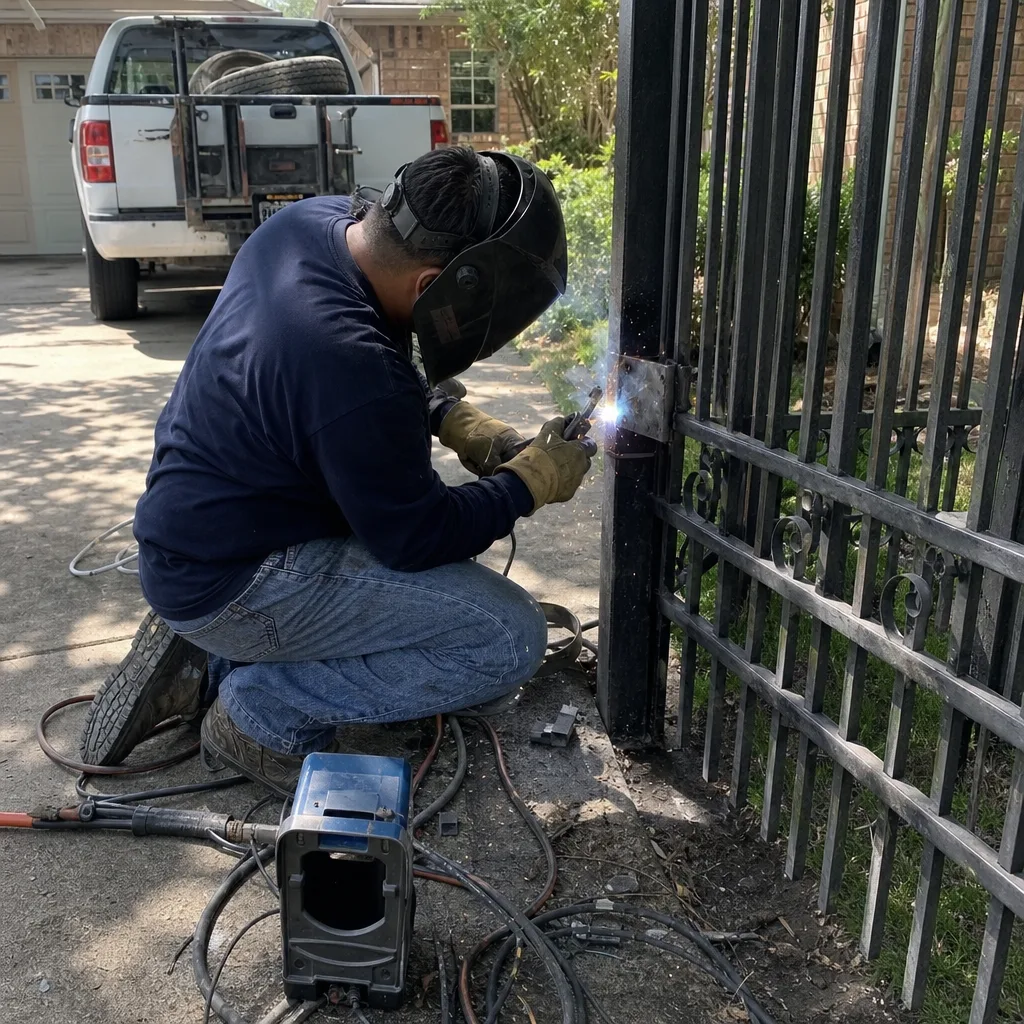
Ground-level weld seams fail first. Every weld at the bottom of the gate structure is a rust initiation point because the heat-affected zone corrodes slightly faster than the surrounding steel, and standing water after Sugar Land thunderstorms keeps those seams wet. Inspect the bottom twelve inches of every welded joint twice a year, especially the corners of the frame and the junction between the pickets and the bottom rail. Record any rust bloom location and size. Small surface rust is treatable with a wire brush and touch-up paint. Rust that has penetrated the weld is structural; that’s a Gate Installation in Sugar Land level concern or at minimum a welding repair.
The pattern to internalize: Sugar Land’s climate doesn’t create new gate failure modes. It accelerates the standard ones. The fix is frequency. A gate in Sugar Land needs hinge inspection more often, condensation checks more often, and weld-seam inspection more often than the same gate in a dry climate. Your checklist stays the same; your interval shortens.
Owner-Serviceable vs. Technician-Only: Where the Line Is
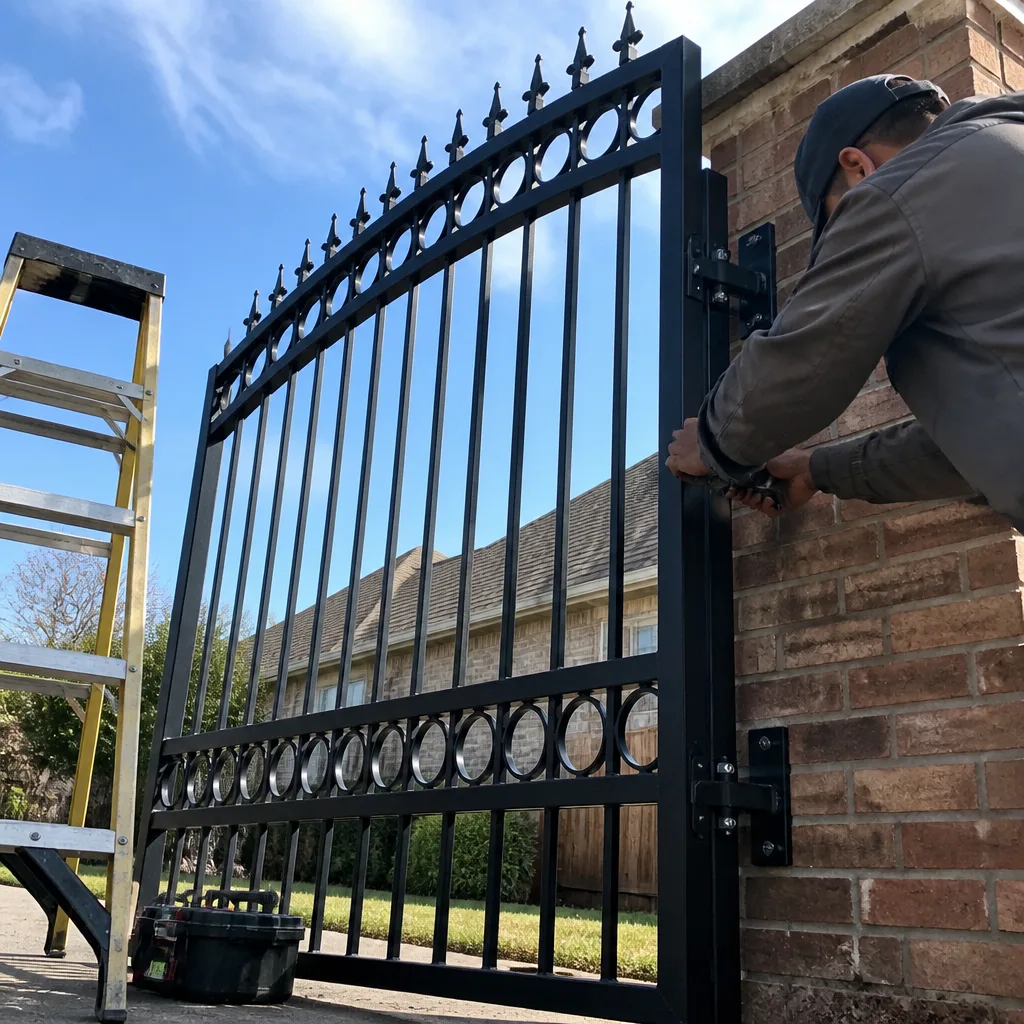
There are exactly three categories of gate maintenance tasks: what you should do yourself, what you should check but never adjust, and what you should not touch at all. The line between them is drawn by what happens when the adjustment is wrong. Lubrication wrong means a sticky hinge. Limit switch wrong means a gate that slams through its stop, strips a gear, or reverses unpredictably onto a vehicle.
Owner-serviceable: debris clearance from track and path, lubrication of hinges and drive chains per manufacturer guidance, photo-eye lens cleaning, visual inspection for rust and physical damage, cycle time and sound recording, photograph documentation, and rust surface treatment (wire brush and touch-up paint on non-structural surfaces only). These tasks share a common trait: if you do them wrong, the consequence is visible immediately and reversible.
Check but never adjust: limit-switch position, force and torque settings, photo-eye alignment correction, battery condition beyond voltage recording, and any electrical connection inside the operator enclosure. You can measure these, photograph them, and record their values. You should not move them. A limit switch that was set 12 degrees past travel is a technician call, not a homeowner adjustment. We document these readings on every service visit precisely so the next technician knows what the setting was; your log serves the same function between visits.
Do not touch: anything involving the operator’s capacitor, the motor windings, the control board, or the mains power connection. Capacitors retain charge. Control boards are static-sensitive. Mains power is mains power. A Viking operator’s capacitor, for example, can discharge through you even with the breaker off if it hasn’t been properly drained. This is not a statement about skill level; it’s a statement about the tools and training required. The Gate Motor & Opener in Sugar Land specialists exist for exactly this reason.
The practical version of this section: do the monthly and quarterly items yourself, record everything, and use your log to make the call when a number drifts outside your baseline. That call goes to (346) 295-3437, and the written estimate you receive tells you what the technician found, what it costs, and what the fix involves before any work begins.
Photographic Baseline: How to Document Gate Geometry
Geometry is the gate’s skeleton. Post plumb, gap uniformity, and ground clearance are the three measurements that tell you whether the structure itself is moving, independent of any electrical or mechanical component. These are best captured as photographs from consistent positions, supplemented by tape-measure readings at the same points each inspection.
Post plumb. Place a level against each gate post, front face and side face. Record the bubble position. A post leaning a quarter degree today that leaned at zero degrees six months ago is a structural issue developing. In Sugar Land’s expansive clay soils, posts move seasonally as moisture content changes. You may see slight cyclical variation, which is normal. What you’re watching for is a one-way trend over multiple checks; that’s settlement, and it will eventually bind the hinge or change the gate’s balance.
Gap uniformity. Measure the gap between the gate leaf and the post at three heights: top, middle, and bottom. For a pair of swing gates, measure the gap between the leaves at the same three heights when closed. Record all six numbers. A gate that measured 3/4 inch at top, middle, and bottom and now measures 3/4 inch at top, 5/8 inch at middle, and 7/8 inch at bottom is telling you the leaf is twisting or the hinge is wearing unevenly. The numbers are small; the meaning is significant.
Ground clearance. Measure the gap between the bottom of the gate and the driveway surface at the hinge end and the latch end. Record both. Driveways in Sugar Land shift with soil movement, and a gate that once had two inches of clearance may find the driveway rising toward it after a wet season. If clearance drops below an inch at any point, address it before the gate starts scraping, because scraping adds load to the motor and accelerates every wear item in the system.
Take your photographs from a fixed position each time: stand at a marked point, use the same zoom level, and frame the gate the same way. The consistency matters more than the photographic quality. Three years of phone photos from the same spot produce a visual record no written checklist can match. This is the exact thinking behind Vance Gate Repair Sugar Land home‘s documented photo record on every service visit: the photo is the evidence of what was there before and what was left after.
The Maintenance Log Template: Two Minutes for the Next Technician
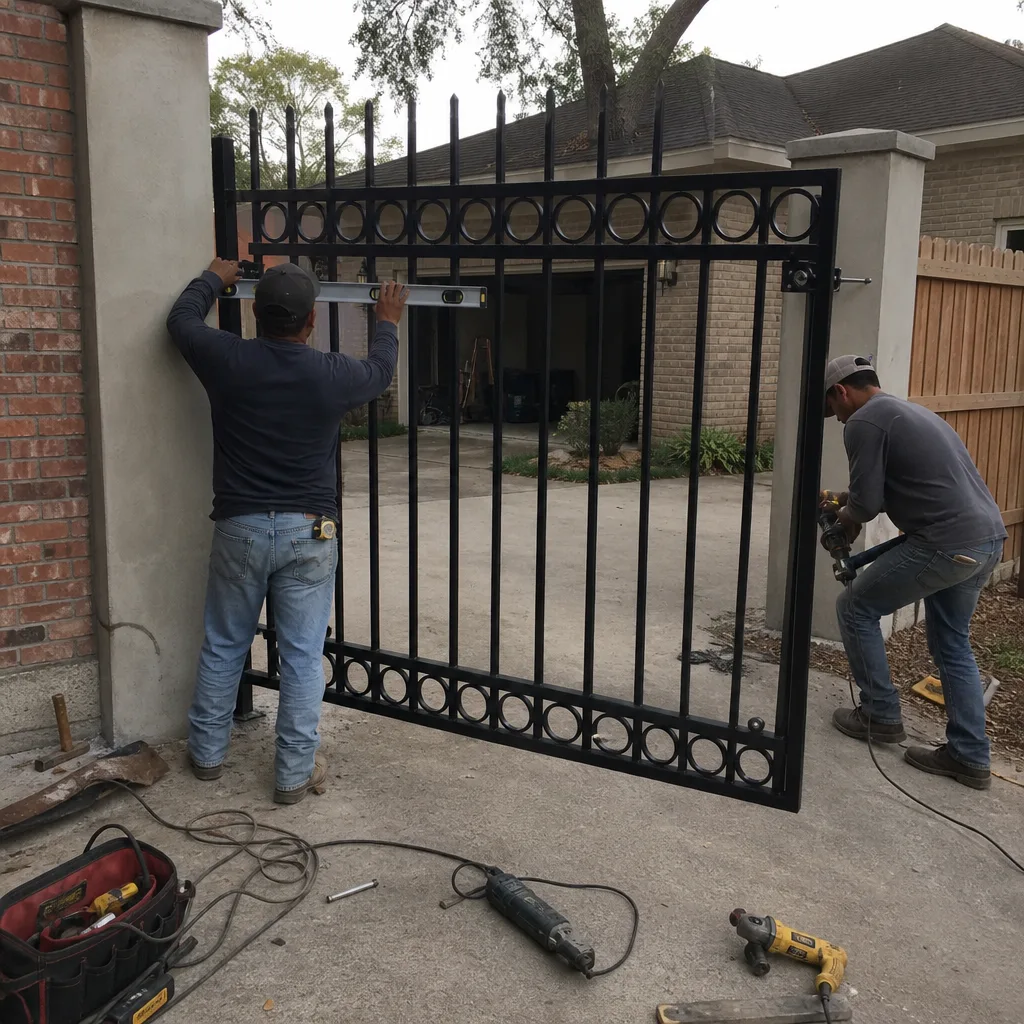
Your maintenance log is the single highest-value document you can produce as a gate owner. It doesn’t matter whether you keep it in a notebook, a spreadsheet, or a notes app. What matters is that it contains specific numbers, specific dates, and specific locations, and that any future technician can read it in two minutes and understand the gate’s history without asking you a single question. Here is the template, field by field.
Baseline Entry (first inspection)
- Date: [date of first full inspection]
- Gate type: slide or swing, single or double leaf
- Operator brand and model: e.g., FAAC 390, BFT Deimos, Linear LRA, Viking F-1
- Open cycle time: [seconds, measured from first movement to full stop]
- Close cycle time: [seconds]
- Close torque or force reading: [from operator display, if available]
- Battery resting voltage: [volts, if battery backup present]
- Ground clearance, hinge end: [inches]
- Ground clearance, latch end: [inches]
- Gap, leaf to post, top/middle/bottom: [three numbers]
- Post plumb, front face and side face: [level bubble position]
- Rust locations noted: [specific description, including size]
- Photo file reference: [folder or album name]
Subsequent Entries
On every later inspection, record the same measurements and add one line: Change since last reading. That line is the whole point. “Close cycle time increased from 11.2s to 13.1s; no other changes noted” is more useful than twenty lines of unchanged data. The change line is what lets a technician say with confidence whether a problem is new or longstanding. When we arrive at a gate for Gate Repair in Sugar Land, the first thing we ask is what changed and when. A homeowner with a maintenance log answers that question in thirty seconds. A homeowner without one answers it with a shrug, and the diagnostic process starts from zero.
If you want a paper version, print the template above and keep it in a zip-lock bag inside the operator enclosure’s outer housing, away from the electrical components. If the gate fails completely and the operator is dead, the log is still accessible. That’s the same logic behind the Haven Standard’s documentation habit: the record survives the failure, so the next visit doesn’t have to rediscover what was already known.
Common Mistakes to Avoid
- Lubricating the track on a slide gate. The wheels roll on the track; they don’t slide on it. Grease or oil on the track reduces traction, collects grit, and accelerates wheel wear. Keep the track dry and debris-free. If a slide gate tech tells you to lubricate the track, get a second opinion.
- Adjusting limit switches without recording the original position. The limit switch sets where the gate stops. Moving it without marking the starting position means you can’t return to the known-good setting. On most operators, limit adjustment interacts with the force sensing and the reversing system, so an incorrect limit setting can make the gate unsafe in ways that aren’t obvious during a test.
- Waiting until the gate fails to establish a baseline. The most valuable measurement you’ll ever record is the first one, taken when the gate is working correctly. Every later comparison depends on it. If you haven’t baselined your gate yet, do it this weekend. The ten minutes it takes is the cheapest diagnostic tool you’ll ever own.
- Treating battery backup as a set-and-forget component. Batteries age whether they’re used or not. A battery that only gets exercised during power outages is a battery that will fail during the next power outage. Check resting voltage twice a year and note any decline trend. Most gate batteries should be replaced on a schedule of every three to five years, not at the moment they die.
- Ignoring rust below the six-inch line. Sugar Land’s standing water after thunderstorms keeps the bottom of the gate structure damp long after the driveway looks dry. Rust at ground level is the precursor to structural failure, not a cosmetic issue. Treat it early. The fix is measured in minutes; the cost of ignoring it is measured in new steel and welding time.
- Overtightening hinge bolts to fix a sagging gate. A gate that sags is telling you the hinge is worn or the post has moved. Cranking the bolts tighter doesn’t fix either problem and can strip the threads or crack the bracket. Measure the gap uniformity instead, record the numbers, and if the gap is closing, call a professional rather than applying more torque.
- Recording “checked, all good” without numbers. A maintenance log that contains only qualitative entries is a diary, not a diagnostic tool. Write down the cycle time, the voltages, the gap measurements. Specific numbers are what let a future technician see change over time, which is the entire value of maintenance documentation.
When to Call a Professional
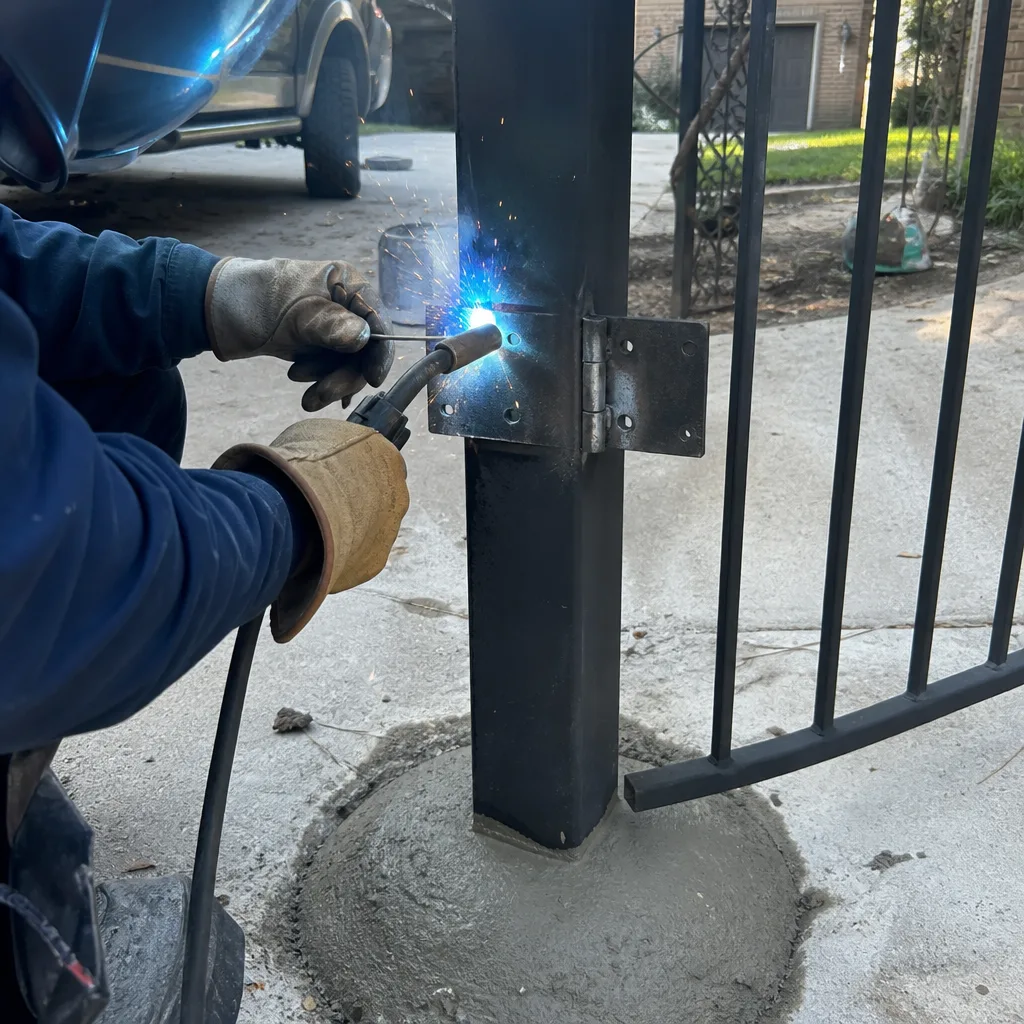
Some findings on your checklist require a technician regardless of your comfort level with tools. Call a professional when: the close cycle time increases by more than 15 percent from baseline without an obvious obstruction; the operator makes a new grinding, buzzing, or clicking sound; the gate reverses unexpectedly or stops mid-cycle; battery voltage shows a downward trend across consecutive checks; rust has penetrated beyond surface bloom into the weld or the structural member; or the gate has contacted a vehicle, a person, or a pet. These are not adjustment issues; they’re diagnostic calls. Vance Gate Repair Sugar Land offers free estimates in Sugar Land; call (346) 295-3437 and you’ll get a written price before any work begins, along with a photo record of what was found on the visit.
Frequently Asked Questions
Every three months is the right interval for Sugar Land’s humidity, which accelerates lubricant breakdown. Two or three drops of a lithium-based or synthetic lubricant per hinge pivot, worked into the joint by moving the gate through its arc twice, and wiped off with a cloth to remove excess. If you hear a dry creak between quarterly intervals, lubricate sooner and note the date; a hinge that’s consuming lubricant faster than expected is showing early wear. For an exact recommendation on your specific gate, call (346) 295-3437 and we’ll walk through it.
Professional gate maintenance visits in Sugar Land typically run between $95 and $180 for a single gate, depending on whether it’s a slide or swing configuration and whether the operator requires diagnostic equipment. A full service that includes lubrication, limit-switch verification, force adjustment, and battery testing falls in that range. If the visit uncovers a needed repair, you’ll get a written price for that repair before any additional work starts. Call (346) 295-3437 for an exact quote; estimates are free.
No, limit-switch adjustment is a technician-only task because the limit position interacts with the force settings and the safety reversing system. An incorrectly set limit can cause the gate to slam through its stop, strip a gear, or reverse unpredictably. What you can do is measure and record the cycle time and listen for changes in the stop sound, then call a professional with that information if anything drifts from baseline.
Check for standing water around the gate posts, track, and operator housing. Clear debris from the track. Inspect the bottom twelve inches of the gate structure for fresh rust. Check the inside of the operator enclosure for condensation. If the gate operated during or after the flooding, note any change in sound or cycle time in your maintenance log. If the operator got wet, disconnect power at the breaker and call (346) 295-3437 before attempting to operate it.
The core maintenance routine is the same across every automation brand: debris clearing, hinge lubrication, photo-eye cleaning, and baseline measurement recording. Different brands do display diagnostic information differently. FAAC and BFT operators commonly show status and error codes through the control-board LEDs or a diagnostic handset, which makes the twice-yearly readings easier to collect if you know where to look. If your operator manual isn’t clear, call (346) 295-3437 and we’ll walk you through reading the diagnostics on your specific model.
With regular maintenance, most residential gate operators last 8 to 12 years before replacement. Sugar Land’s humidity shortens that lifespan primarily through control-board and capacitor deterioration rather than mechanical motor wear, so the twice-yearly enclosure inspection matters more here than in drier climates. If your operator is older than eight years and showing electrical drift in your log, start budgeting for replacement rather than waiting for failure. For a professional assessment of your operator’s condition, call (346) 295-3437; the estimate is free and written before work begins.
The Bottom Line
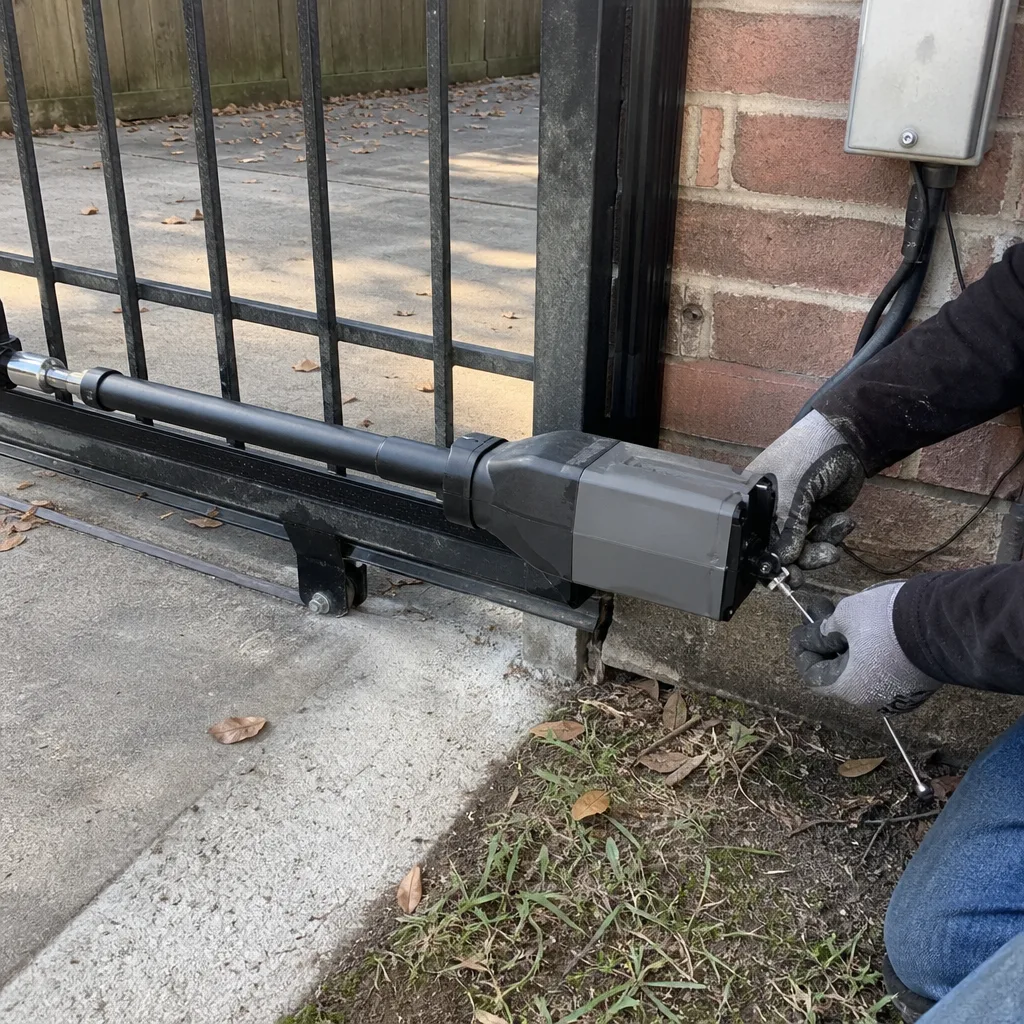
A gate maintenance checklist only works if it produces data you can compare. The monthly check clears and observes. The quarterly check lubricates and photographs. The twice-yearly check measures cycle time, close torque, battery voltage, and gate geometry against the baseline you recorded. In Sugar Land, that schedule is non-negotiable because humidity, standing water, and expansive soil work faster than they do elsewhere. Keep the log. Record the numbers. When a number drifts, call a professional before the component fails. The gate that lasts twenty years was maintained for nineteen of them.
Written by Adrian Vance, Owner at Vance Gate Repair Sugar Land, serving Sugar Land since 2014.